
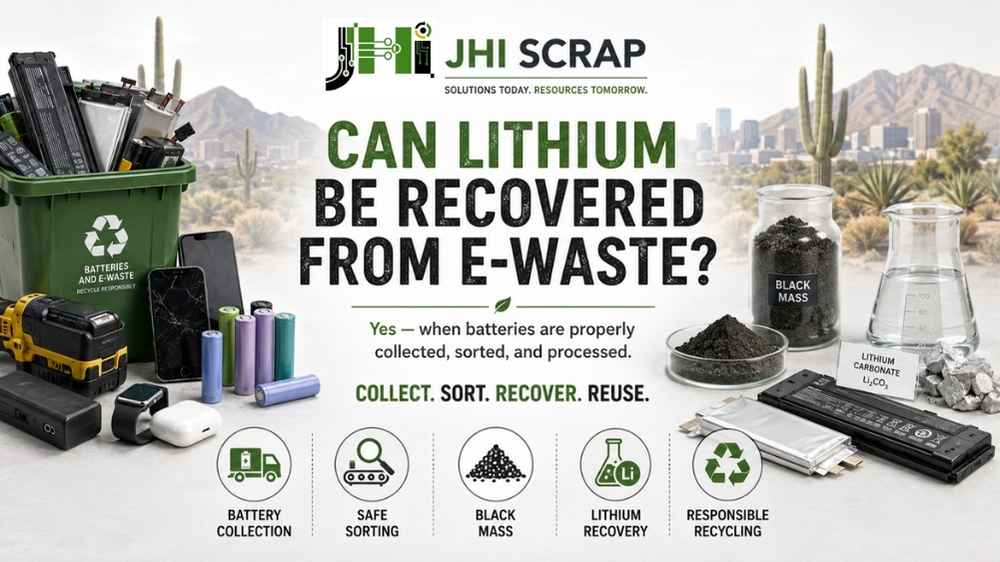
Can Lithium Be Recovered From E-Waste?
Yes, lithium can be recovered from e-waste. It happens right now, at real plants, using real chemistry. But recovery is never automatic, and that is the part most people miss. Lithium only comes back when the right hands handle your old device.
Toss a dead laptop in a dumpster and that lithium is gone. Hand it to a proper recycler and it can live again inside a new battery. Out here folks say the desert keeps whatever you drop. Old electronics follow the same rule.
This guide walks through the whole thing. How lithium gets pulled out. Why it often does not. What it costs. And what to ask before you hand anything over to anybody.
The Short Answer, With The Fine Print
Lithium recovery is technically solved. Commercial plants pull lithium, cobalt, nickel, and manganese out of spent cells every day. Some newer processes recover well over 90% of the lithium in a batch.
So why does so little lithium actually come back? Because the technology was never the bottleneck. Collection is. Economics is. Chemistry choices are.
Here is the honest framing. Lithium recovery is a supply chain problem wearing a science costume. The lab work is done. The hard part happens in loading docks, storage rooms, and garages across Maricopa County.
That means your decision matters more than you would think. As they say around here, water only runs where you dig the ditch.
What Lithium Is Doing Inside Your Old Devices
Lithium sits in the battery, not the circuit board. That trips up a lot of smart people. Circuit boards hold gold, silver, palladium, and copper. Batteries hold the lithium, and the two get handled very differently.
Lithium also sits on the federal critical minerals list. So do cobalt, nickel, manganese, and graphite, which all ride along in the same cell. Critical means hard to source and important to the national economy. So recovery is not a feel-good extra. It is supply.
The devices most people forget
Everybody remembers the phone and the laptop. Then the rest of the pile gets missed. That is where the risk hides.
- Cordless tools and vacuums. Drills, impact drivers, and stick vacuums all carry lithium packs.
- UPS and backup power units. Newer models have swapped from lead-acid to lithium.
- Tablets, e-readers, and smartwatches. Small cells, glued in, easy to puncture.
- Bluetooth speakers and headphones. Tiny pouch cells that swell without warning.
- Security cameras and doorbells. Often forgotten in a drawer for years.
- E-bikes and scooters. Large packs, high energy, serious fire risk.
- Lab, medical, and test equipment. Backup cells inside gear nobody thinks of as a battery.
If it charges without a cord, assume it has lithium inside. That single rule of thumb prevents most accidents.
How much lithium is actually in there
A 3,500 mAh phone battery holds roughly 0.45 grams of lithium. That is about three grains of rice. Sounds like nothing, right? Now multiply it by every junk drawer, closet, and storage room in the Valley.
A laptop pack holds several times that. An e-bike pack holds far more again. Volume changes the math completely. One phone is a curiosity. Ten thousand phones is a feedstock.
For a business, this stops being abstract fast. A single office refresh can move hundreds of battery-bearing devices at once. That is a stream, not a trickle. Small piles add up, and a drop at a time fills the bucket.
How Lithium Is Actually Recovered From E-Waste
Recovery runs through a chain. Every link has to hold, or the lithium quietly drops out along the way. Here is the plain-English version of how lithium-ion batteries are recycled, start to finish. As the old ranch saying goes, a fence is only as strong as the weakest post.
Step 1: Collection and sorting
Devices arrive from offices, homes, drop-offs, and equipment refreshes. Batteries get pulled, identified, and sorted by chemistry. It is slow, unglamorous work. It is also where most of the value gets saved or lost.
Sorting matters more than almost anything downstream. A clean stream of one chemistry can be processed precisely. A mixed stream gets treated like a lowest common denominator. Value evaporates the moment things get jumbled.
This is also where a lot of small recyclers quietly give up. Sorting costs labor, and labor costs money. So the batteries get lumped in with everything else.
Step 2: Discharge and dismantling
Cells get discharged first so they cannot spark. Then trained staff remove hazardous parts by hand. Batteries come out. Screens come off. Boards with precious metals get set aside.
Why not just shred everything and sort it later? Because batteries explode in shredders. That one design decision separates safe operations from expensive fires.
Manual dismantling is slow and it is not optional. Anybody who skips it is gambling with a building.
Step 3: Shredding and black mass
Once the hazards are out, the rest goes through a shredder under controlled conditions. What comes out is a gritty dark powder called black mass. That powder holds the shredded cathodes and anodes.
Black mass is the paydirt. Everything after this step is about pulling metals back out of that powder. It looks like nothing. It is worth a great deal.
There is no single industry standard for black mass composition. Content varies with what got shredded and how. That variability causes real headaches downstream, and it is a live policy issue worldwide.
Step 4: Smelting (pyrometallurgy)
This is the heat route. Furnaces run hot enough to melt the metals apart. Cobalt and nickel come out well.
Lithium is the problem. It mostly ends up locked in the slag. Recovering it from there takes extra steps that many operators historically skipped.
Think of smelting as burning a fruitcake to get the cherries. You get some back. You lose plenty. It works at scale, but it burns energy and it wastes lithium.
Step 5: Leaching (hydrometallurgy)
This is the chemical bath route. Acids or solvents dissolve the metals out of black mass. Then chemists pull each element back out of solution.
Leaching can economically recover lithium, cobalt, nickel, and manganese together. That is the key sentence in this whole article. If you want lithium back, this is the route that gets it.
Leaching is more like soaking that fruitcake apart in water. Slower, gentler, and far more of the good stuff survives. Several US facilities are built around this approach.
Some research processes push lithium recovery above 95% under lab conditions. Commercial results run lower, but the trend is clear. Around here we say a slow horse still finishes the race.
Step 6: Direct recycling
A newer method skips the full teardown. It keeps the engineered cathode structure intact and refreshes it instead. The cathode is the most valuable and most heavily engineered part of the cell.
Rebuilding it from scratch wastes all that engineering. Direct recycling avoids that waste, and it saves a large amount of energy. It is still mostly pilot scale. But it is coming, and it will change the math again.
Want the deeper technical walk-through? Our breakdown of e-waste recycling methods covers every stage in detail.
Why Lithium Got Skipped For So Long
Money. That is the honest answer, and nobody in the industry will pretend otherwise. For years, cobalt and nickel paid the bills at recycling plants. Lithium was cheap enough that chasing it made no sense.
So plants went after the expensive metals and let lithium sit in the slag. It was not a cover-up. It just did not pencil out. Around here we say you do not dig a well for a cup of water.
Two things flipped that. Battery demand exploded, and the rules grew teeth. The EU now requires 50% lithium recovery by 2028, rising to 80% by 2032. Targets like that reshape what plants get built and what processes get funded.
Price swings did the rest. Lithium carbonate roughly doubled from about $13,400 per tonne in December 2025. It passed $26,000 per tonne in January 2026 before easing back. When a metal moves like that, recovery projects get funded fast.
The LFP Problem Nobody Saw Coming
Here is a wrinkle almost nobody outside the industry knows about. Battery chemistry changed, and it broke a lot of business plans.
LFP stands for lithium iron phosphate. It made up over half of global EV battery deployment in 2025. It is also the default choice for stationary storage systems.
LFP is safer, cheaper, and lasts longer. Sounds great, right? For recyclers, it is a headache. LFP has no nickel and no cobalt. Those were the metals that made recycling profitable in the first place.
So recyclers who sized their plants for nickel-rich feedstock are now facing a nickel-free stream. In some 2026 cases, quotes for recycling an end-of-life pack came back negative. The owner would have to pay to have it taken.
Why does this matter to you? Because it explains why some companies quietly stopped taking batteries. It also explains why paperwork and certification matter more than a low price. A cheap quote from a company with no downstream route is not a bargain. It is a liability with a receipt.
Policy will eventually force the issue. Extended producer responsibility rules shift recycling costs onto manufacturers. Until then, chemistry decides economics, and economics decides what actually gets recovered. You cannot brand your way past a spreadsheet.
What Black Mass Is, And Why It Started A Trade Fight
Black mass sounds like industrial trivia. It is actually at the center of a global regulatory fight. That fight shapes where your old battery ends up.
The EU classified black mass as hazardous waste effective March 5, 2025. Under the Basel Convention framework, hazardous waste cannot be freely exported to non-OECD countries. So European black mass largely cannot ship to China.
China moved the opposite direction. Starting August 1, 2025, compliant recycled black mass is treated as non-waste there. It can be imported without the old restrictions.
Two major economies, two opposite calls, same material. The result is a thin and volatile global market. Compliant shipments cost more and move slower.
Meanwhile the United States has a black mass oversupply. Much of it still gets exported. Domestic refining capacity has not caught up with shredding capacity. There is a lesson in that. Shredding is easy. Refining is hard.
For a Phoenix business, the practical takeaway is simple. Ask where the material goes after it leaves the building. A recycler who can name the route is telling you something real. One who cannot is hoping you do not ask twice.
How Much Lithium Are We Really Talking About?
Less than 5% of spent lithium-ion batteries get recycled worldwide. Read that again. The gap between what is technically possible and what actually happens is enormous.
By 2030, end-of-life batteries could supply a meaningful share of global lithium demand. But only if they get collected first. A battery in a landfill is worth exactly zero, no matter how good the chemistry gets.
The United States is building serious capacity. Redwood Materials processes roughly 20 GWh of lithium-ion batteries a year. That is close to 90% of all Li-ion recycled by volume in North America. The company produces more than 60,000 tons of critical materials a year.
Others are scaling too. Li-Cycle’s Rochester Hub was designed as North America’s first commercial-scale hydrometallurgical facility. A $475 million Department of Energy loan was finalized in November 2024. Ascend Elements built a $65 million plant in Kentucky. It is sized for up to 24,000 metric tons a year.
The capacity is arriving. The feedstock is the question. Plants are running below capacity because collection has not kept pace. That is the whole story in one sentence.
Recovered Lithium Versus Mined Lithium
People assume recycling is the greener choice and leave it there. The actual comparison is more interesting, and it matters more in Arizona than most places.
Primary lithium comes from two main sources. Hard rock mining, mostly spodumene, and brine evaporation ponds. Brine operations pump salty groundwater and let the sun do the work over many months.
That process uses enormous volumes of water in dry regions. Anybody who has lived through an Arizona summer understands why that raises eyebrows. Water is the currency here, and everybody knows it.
Recovery skips all of that. No new pit. No new evaporation pond. No new haul road. The lithium already exists in refined form, sitting inside a device.
Recovery is not free of impact. Leaching uses chemicals. Smelting uses energy. Transport burns fuel. But the footprint comparison generally favors recovery, especially on land and water.
There is a second benefit that has nothing to do with the environment. Recovered material is domestic material. It does not sit on a boat. It does not depend on somebody else’s export policy. In a tight market, that is worth real money.
The Fire Risk Nobody Mentions Until It Is Too Late
This is where Phoenix needs to pay real attention. Lithium cells behave beautifully in normal use. They turn dangerous when they get crushed, punctured, or cooked.
Fire Rover tracked 448 lithium battery fires at US and Canadian waste sites in 2025. Damage topped $2.5 billion. The EPA has also found most discarded lithium-ion batteries are likely hazardous waste. They can be ignitable and reactive.
The mechanism has a name. Thermal runaway. One damaged cell heats up, which damages the next cell, which heats up further. The reaction feeds itself and does not need outside oxygen to keep going.
That is why a lithium fire behaves differently from a paper fire. Water cools it but does not simply put it out. Once a pack goes, it goes.
Why Phoenix heat makes this worse
Now picture a Phoenix garage in July. Ambient air hits 115 degrees outside. A closed garage or a metal storage shed runs far hotter.
A sealed box of old laptops baking at those temperatures is not a storage plan. It is a slow fuse. Heat accelerates cell degradation and pushes marginal batteries over the edge.
The dry climate helps electronics in one way. Less corrosion means better recovery quality later. But heat is the tradeoff, and heat is the dangerous half. Old-timers here say never leave in the truck bed what you would hate to lose.
Warning signs a battery is going bad
Learn these. They are easy to spot once you know them.
- Swelling or puffing. A laptop that no longer sits flat is a warning, not a quirk.
- A trackpad or case that bulges. Same cause, different symptom.
- Heat when idle. A device warm while off is not normal.
- A sweet chemical smell. That is electrolyte, and it means the seal is compromised.
- Discoloration or leaking residue. Stop handling it and isolate it.
- Sudden charge collapse. A battery that drops from full to dead has failing cells.
If you see any of these, do not toss the device in a bin. Move it to a nonflammable container away from paper, fuel, and anything that burns.
Two rules cover most of the risk. Never put lithium batteries in a curbside bin, because that is how truck fires start. And never store swollen batteries indoors while you decide what to do.
Phoenix Is Sitting On A Quiet Lithium Mine
There is a name for this idea. It is called urban mining. The term was coined in Japan in the 1980s. The field has been serious ever since.
The premise is simple. The metals we need are already here, sitting in gear we stopped using. The city is the ore body.
Phoenix is an unusually good candidate. We have dense office corridors, data centers, university labs, and a deep semiconductor supply chain. Add decades of steady growth and you get a lot of retired equipment.
The dry climate helps again. Electronics stored in Phoenix corrode less than those stored in humid regions. Cleaner material means better recovery rates when it finally gets processed.
The difference between an ore body and a landfill is logistics. Someone has to collect it, sort it, and route it to a processor that recovers lithium. That is the whole game, and it is a local game.
Gold in the ground does nobody any good. Same with a drawer full of dead phones.
What Arizona Law Actually Says About Your Old Electronics
Let’s clear up a common confusion. Arizona does not have a comprehensive statewide e-waste program like some states do. There is no producer-funded takeback mandate covering all devices.
That does not mean anything goes. Businesses in Arizona fall under hazardous waste rules administered by the Arizona Department of Environmental Quality. ADEQ runs the state hazardous waste program under Arizona Administrative Code Title 18, Chapter 8.
Lithium batteries matter here specifically. The EPA has determined most discarded lithium-ion batteries are likely hazardous waste when thrown out. So a business tossing them in a dumpster is not just being careless. It may be a compliance problem.
Legislative efforts keep coming and keep stalling. A 2026 bill aimed at manufacturer-led recycling programs failed to pass. So the patchwork continues, and cities and counties fill gaps with their own rules.
Practical advice for a Phoenix business. Do not rely on a blog post for your compliance position, including this one. Confirm your obligations with ADEQ or your environmental counsel. Then document what you did with your equipment.
Documentation is the part people skip. It is also the only part an auditor can see. Talk is cheap, but paper keeps.
What Phoenix Businesses Should Do With Battery-Powered Gear
Business gear is where the volume lives. Laptops, UPS units, tablets, handheld scanners, and cordless tools all stack up fast. A proper IT asset disposition program handles batteries, data, and paperwork in one pass.
Here is the practical sequence that works.
- Inventory before you box anything. Count devices and note anything swollen, hot, or leaking.
- Separate loose batteries. Tape the terminals and keep them out of the general pile.
- Handle data first. Drives and phones need wiping or destruction before shredding.
- Book one pickup, not five. Fewer moves means less handling risk and cleaner records.
- Keep the paperwork. Receipts and certificates are what an auditor actually wants to see.
Timing matters more than people expect. Gear that sits three years in a hot storage room loses value and gains risk. Retire it on a schedule instead of when the room fills up.
There is also a quiet financial upside. Working equipment can carry real resale value. Test equipment, servers, and lab gear often do. Recycling should not be the first assumption for anything that still runs.
Want the bigger regional picture? Our look at the urban mining opportunity in Phoenix explains why local recovery wins.
How To Prep Old Devices Before Pickup
A little prep protects everyone in the chain. It also speeds up your quote. Start by pulling devices out of hot storage and into a cool, dry spot indoors.
Do not puncture, crush, or pry at any battery. Glued-in cells rupture easily, and that is exactly how a small job becomes an emergency. Keep chargers and cables with their devices, since intact units are easier to test and reuse.
If you are a homeowner or renter
Sort into three simple piles. Working equipment, dead equipment, and anything damaged or leaking. That single step makes the whole handoff cleaner.
Sign out of accounts before you hand over a phone or tablet. Remove SIM cards and memory cards. Then do a factory reset if the device still powers on.
Keep everything indoors and out of direct sun until pickup day. A cool closet beats a hot garage every time.
If you run an office, school, or property
Assign one person to own the process. Split responsibility means nobody checks the storage room. That is how a swollen battery sits unnoticed for a year.
Use a staging area with a hard floor and no clutter. Keep it away from paper storage and cleaning chemicals. Label anything damaged before it goes in the pile.
Then schedule one consolidated pickup instead of a slow drip. Fewer touches mean lower risk and cleaner records. Our guide on how to recycle electronics in Arizona covers the rest.
How To Tell If A Recycler Really Recovers Lithium
Now for the part you came for. Anybody can paint recycling on a truck. Fewer can tell you what actually happens on a Tuesday afternoon at the plant. As the saying goes, do not buy a horse by the saddle.
Ask these five questions and listen closely.
- Where do the batteries go downstream? A real answer names a processor and a route, not a vague promise.
- Do you sort by chemistry? Mixed loads tend to get smelted. Sorted loads have a genuine shot at lithium recovery.
- What happens to my data? Wiping or physical destruction should happen before anything hits a shredder.
- Do you follow R2 or e-Stewards? These are audited standards, not badges you buy.
- What paperwork do I get? A receipt or certificate turns a promise into a record you can hand an auditor.
There is a sixth question worth adding for businesses. Ask how long the company has been operating in the Valley. Downstream relationships take years to build, and a new logo does not build them overnight.
If a company dodges the downstream question, that is your answer. Trust gets built on specifics, not slogans.
Red Flags That Should End The Conversation
Some answers should stop the discussion right there. Not because the company is necessarily bad, but because the risk lands on you.
- “We recycle everything responsibly.” That is a slogan. Ask for the actual route.
- No physical address you can visit. A broker is not a processor, and the difference matters.
- Cash only, no paperwork. If nothing is documented, nothing can be proven later.
- Refusing to discuss data handling. Your liability does not transfer with the pallet.
- Wildly cheap pricing with no explanation. Somebody is skipping a step, and it is usually the expensive one.
- Vague answers about batteries. Batteries are the hardest part. Confidence there tells you a lot.
Your name stays attached to your equipment. Chain of custody exists so that stops being true at a documented point. Skip it and you are just hoping.
What Does It Cost To Recycle Lithium-Bearing Electronics?
Pricing depends on three things. What you have, how much of it there is, and how much handling it needs.
Working equipment and clean commercial gear can carry real value back to you. Servers, test equipment, and surplus electronic components often do. Damaged batteries and mixed consumer loads cost more to process safely, because safe handling is labor.
Volume changes everything. A single pallet is a different job than a warehouse cleanout. Route efficiency is real, and it shows up in the number.
A fair recycler tells you which bucket you are in before the truck rolls. No surprise fees on pickup day. No vague estimates that grow once your gear is loaded. You should get a number, in writing, up front.
Ready to find out what your old electronics are worth? Jay Hoehl Inc. has been recycling electronics in Phoenix since 1980. We hold an A+ BBB rating and a long record with local businesses. Call (602) 272-4033 to schedule a pickup or request a free evaluation. It costs you nothing to ask.
What Happens To The Rest Of The Device
Lithium is the headline, but it is a small share of the mass. The rest of your laptop has its own destinations.
- Circuit boards go to precious metal recovery for gold, silver, and palladium.
- Aluminum and steel casings return to smelters as clean scrap feedstock.
- Copper wiring and heat sinks are among the most valuable recovered materials by weight.
- Screens and glass get separated, with older panels needing special handling.
- Plastics are sorted by resin type where practical and processed accordingly.
- Rare earth magnets in hard drives hold neodymium and dysprosium.
A working device is worth more than the sum of these parts. That is why reuse always beats recycling when the equipment still runs. Reuse extends the life of everything already built into it.
Recycling is the floor, not the ceiling. The best outcome is a device that keeps working for somebody else.
Where Lithium Recovery Is Headed Next
A few things are shifting at once, and they all point the same direction.
Direct recycling is scaling up. Preserving cathode structure saves energy and cost. If it reaches commercial scale, the economics change for everybody.
Regulation is tightening. The EU targets are the leading edge. Where Europe goes on battery rules, other markets often follow within a decade.
Domestic refining is being built. The US has plenty of shredding capacity and not enough refining. That imbalance is closing, slowly.
Design is starting to change. Glued-in batteries are getting political attention. Repairability rules and battery labeling requirements make recovery easier at the far end.
Feedstock is the constraint. Plants exist and run under capacity. Collection is the bottleneck, which means ordinary decisions carry weight.
That last point is the one to sit with. The industry does not need a breakthrough to recover more lithium. It needs the batteries to show up.
Frequently Asked Questions
Can lithium really be recovered from a phone battery?
Yes. A phone cell holds roughly 0.45 grams of lithium. Leaching can recover most of it. The catch is that the phone has to reach a processor running that route.
Is lithium recovery better than mining new lithium?
Recovery uses less land and water and skips new extraction entirely. It also keeps hazardous cells out of landfills and trash trucks. Mining still fills most demand today, but recovery is closing the gap.
Can I throw lithium batteries in my Phoenix curbside bin?
No. Damaged or discarded lithium batteries can ignite inside collection trucks and sorting facilities. They belong at a proper collection point or with a licensed recycler.
What is black mass?
It is the granular powder left after shredding battery cells. It contains the cathode and anode material. Lithium, cobalt, and nickel all get recovered from it.
Why do some recyclers refuse batteries now?
Chemistry changed. LFP batteries contain no nickel or cobalt, so the economics got harder. Some operations were built for a feedstock that is no longer arriving.
Do I have to remove the battery before drop-off?
Not usually, and often you should not try. Glued-in batteries can rupture when pried out. Tell the recycler what is in the load and let trained staff handle removal.
What happens to the rest of my laptop?
Metals, boards, plastics, and glass all separate into their own streams. Boards go to precious metal recovery. Steel and aluminum go back to smelters as feedstock.
Is it illegal for an Arizona business to throw out electronics?
Arizona has no comprehensive statewide e-waste law. But businesses fall under ADEQ hazardous waste rules, and lithium batteries are the sensitive part. Confirm your specific obligations before you assume anything.
How should I store old devices before pickup?
Cool, dry, and indoors. Keep them away from paper, fuel, and heat sources. Isolate anything swollen or leaking in a nonflammable container.
Does recycled lithium end up in new batteries?
That is the goal, and increasingly the reality. Recovered lithium gets refined into battery-grade compounds and fed back into cathode production.
What certifications should I look for?
R2 and e-Stewards are the two that carry weight. Both involve outside audits of how material and data get handled. Ask which one applies and to which facility.
Can old EV or e-bike packs be reused instead of recycled?
Sometimes. Packs that no longer meet vehicle range needs can still store energy well. Second-life applications like solar storage are growing, though the market is still young.
The Bottom Line
Lithium can be recovered from e-waste. The chemistry works, the plants exist, and the economics finally make sense for most chemistries. What is missing is collection.
Every laptop that ends up in a dumpster takes its lithium with it. Every device that reaches a real recycler gives it back. Multiply that across the Valley and the numbers stop being small.
You get to decide which pile your old gear joins. That is honestly the whole choice. Everything else in this article is detail hanging off that one decision.
If you are in Phoenix or anywhere in Maricopa County, the next step is easy. Call Jay Hoehl Inc. at (602) 272-4033 or visit 3334 W McDowell Rd, Unit 17, by appointment. Get a free evaluation and a real number. Then clear out the pile for good.