
JHI Scrap • Manufacturing Inventory
Rejected Components and Production Returns: A Disposition Guide
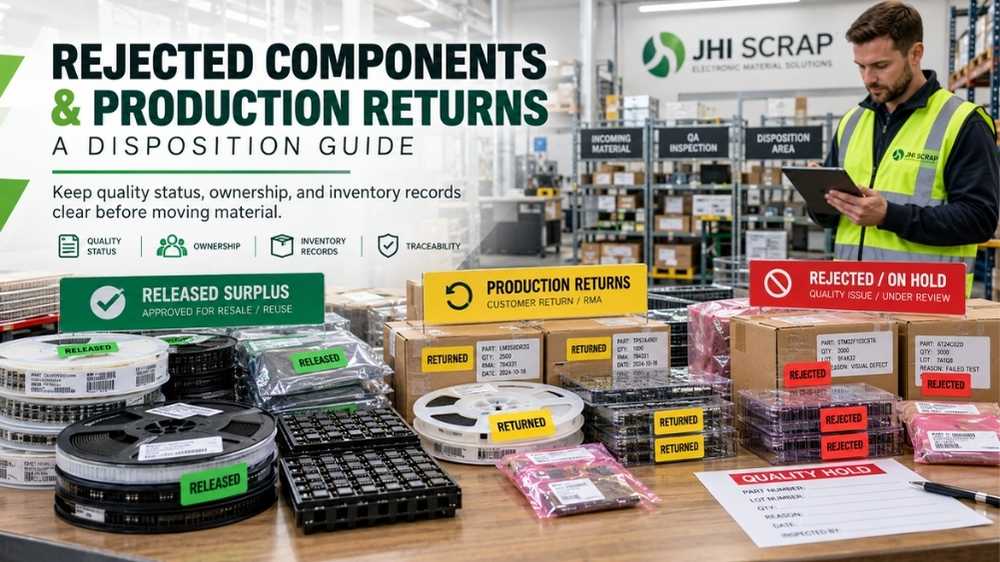
Keep quality status, ownership, and inventory records clear before moving production-return material.
Quick answer
Separate rejected components and production returns from released surplus. Identify why each lot was returned or rejected, confirm who owns it, preserve labels and records, and obtain the required internal disposition approval. Do not describe held or unverified material as usable surplus. Once status is clear, prepare a line-item inventory and ask a qualified buyer about the available disposition options.
Understand the difference between surplus, returns, and rejects
Manufacturing inventory may include usable excess, customer returns, supplier returns, rejected components, and material awaiting inspection. These categories can look similar on a shelf. Their business status is different, so they need separate records and controls.
Released surplus is stock your organization no longer needs and has authority to disposition. Your quality process has released it from any hold. A department may still need to confirm ownership and contract terms.
Production returns are items returned from a production line, program, customer, or supplier process. The reason for return matters. A return may result from a forecast change, a canceled build, excess issuance, packaging damage, a production discrepancy, or a quality concern.
Rejected components have been identified as not meeting an acceptance requirement or are otherwise under a quality restriction. A rejection does not automatically establish the final disposition. The material may require supplier return, rework review, further inspection, controlled retention, or another approved route.
Keep these labels meaningful in your own quality system. Do not substitute a buyer’s description for the company’s formal status. The quality team or other authorized owner should determine whether material can be released, returned, scrapped, or transferred.
When a lot contains multiple statuses, split it into separate lines and containers. JHI’s surplus component inventory template for OEM and EMS sellers can help organize key identifiers and status information.
Segregate material before preparing an offer request
Physical separation reduces the risk of mixing approved and restricted stock. Use containers and locations consistent with your organization’s procedures. Apply status labels that your team understands, and make sure the inventory record matches the physical location.
Do not remove supplier labels, date codes, lot codes, or original packaging without a documented reason. Photograph identifiers before any approved repackaging. If a label is unreadable, record that limitation and keep the questionable lot apart from clearly identified stock.
Use a dedicated line for each combination of part number, lot or date code, quantity, package condition, and disposition status. If one part number appears in both released and rejected quantities, record those quantities separately. Never combine them into one total that hides the difference.
| Status group | Record and handling approach |
|---|---|
| Released surplus | Record release status, owner, identifiers, quantity, and package condition. |
| Return pending | Keep supplier or customer return terms visible; do not offer for sale until authorized. |
| Rejected or on hold | Preserve the quality restriction and route it through the responsible approval process. |
| Unverified | Mark the missing information and keep it distinct from documented, released inventory. |
For mixed lots containing components and other electronics, follow a deliberate sorting method. JHI’s mixed surplus electronics lot sorting guide discusses organizing different material categories before evaluation.
Build a record that explains the material
A disposition record should let another employee understand the lot without relying on memory. Include the manufacturer and complete part number when available. Record the physical quantity, package type, lot or date code, storage location, and current quality status.
Add the reason for return or rejection using your organization’s approved wording. If the reason includes confidential customer details, share only information that your company authorizes. Retain the underlying investigation and supplier correspondence in the appropriate controlled record system.
Record the source of the quantity. A count from an ERP system, sealed package label, physical count, or estimate are not interchangeable. Identify which one applies. If actual count may change during review, say so and update the record after verification.
Keep evidence with the record. Relevant materials may include receiving documents, supplier correspondence, return authorizations, internal nonconformance records, inspection notes, photographs, and approval history. Share only the documents needed for the buyer’s review and authorized by your company.
Do not make unsupported claims such as “tested,” “good,” “new,” or “fully traceable.” Use those descriptions only when your records support them. If the material’s status is unresolved, say that clearly and pause the transaction until the responsible authority decides the next step.
For packaging-specific records, the JHI article on full reels, partial reels, trays, and cut tape offers related guidance. Preserve package distinctions when material is returned from the line or moved between containers.
Before you call something surplus
Confirm ownership, quality release, customer or supplier restrictions, and disposition authority. A part number and quantity alone do not establish that stock is available for transfer.
A practical disposition review process
1. Identify the trigger
Start by recording why the inventory is under review. A program may have ended, a forecast may have changed, a supplier may have issued a return, or an inspection may have rejected a lot. The trigger helps determine who needs to approve the next step.
2. Establish ownership and restrictions
Check purchase records, customer agreements, consignment terms, supplier return rights, and any internal restrictions. Involve procurement, legal, finance, quality, or program leadership as needed. Do not rely on shelf location as proof of ownership.
3. Confirm the quality status
Ask the quality authority whether each lot is released, held, rejected, or awaiting review. Keep disposition approval with the record. If different quantities have different statuses, split them physically and administratively.
4. Prepare an accurate list
Use one inventory line per distinct lot and package condition. Include identifiers, count basis, storage, and known history. Attach photos that show labels and packaging. Keep unclear or unreadable details marked as unknown.
5. Ask about appropriate disposition options
Once the organization approves external review, describe the categories and ask what information is needed. Some material may be considered for reuse, resale, supplier return, further review, or recycling. Do not promise a particular outcome before the material is evaluated.
JHI’s surplus electronics service page describes the broader electronic surplus category. A separate page covers excess inventory management. Share the actual inventory details so the relevant material can be discussed.
6. Confirm scope and transaction details
Before accepting an offer, verify which lots and quantities are included, how any unresolved status will be handled, and what records the parties expect. Confirm the pickup or shipping plan, payment terms, and any required approvals in writing. Keep the approved scope with your records.
7. Reconcile after disposition
After transfer, update inventory records to reflect what left the facility and what remains. Keep the final quantity, supporting paperwork, and approval record together. If the evaluated quantity differs from the original count, document the reconciliation instead of overwriting the earlier record.
Common mistakes that create avoidable risk
- Mixing returns with released stock: Different statuses require distinct lines and clear physical separation.
- Assuming a return is automatically approved for resale: A return may still require supplier, customer, or quality review.
- Removing original labels: Identifiers can be difficult to reconstruct once packaging is changed.
- Calling untested parts “good”: State only what inspection records and authorized personnel can support.
- Using an unverified quantity: Record how the count was obtained and update it after physical verification.
- Ignoring ownership: Customer-owned or consigned inventory may have separate disposition conditions.
- Sharing confidential quality records casually: Follow internal access and disclosure rules.
- Failing to reconcile: Close the record after transfer so system inventory matches what remains.
Make the process repeatable
Production returns become easier to manage when the organization uses consistent status labels and record fields. Define where returns go, who can change quality status, how photographs are stored, and which approvals must happen before an external evaluation.
Review aging return and rejection areas on a regular schedule. Assign a responsible owner and a next action to every lot. Some items may need supplier action, some may need inspection, and others may be released for disposition. A clear owner keeps boxes from becoming permanent inventory.
Use a shared inventory view for purchasing, quality, finance, and operations, while limiting sensitive records to authorized staff. The shared view can show disposition status without exposing confidential investigation details to every user.
JHI’s Phoenix excess inventory management guide is a related resource for teams reviewing accumulated stock. Adapt the review cadence to your production cycle and internal controls.
Frequently asked questions
Can rejected components be sold as ordinary surplus?
Do not treat rejected or held stock as released surplus. Follow your quality process and confirm disposition authority before offering it externally.
Are production returns always defective?
No. A return may have several causes, including excess issuance or a program change. Record the actual reason and status instead of assuming.
What information should a returned-components list include?
Include identifiers, quantity and count basis, package condition, source, lot information, quality status, and the reason for return when authorized.
Should I combine different date codes in one line?
Keep distinct date or lot codes separate when known. Separate records preserve traceability and help the buyer understand the lot.
What if the supplier label is missing or damaged?
Keep the material segregated, photograph what remains, and mark missing identifiers as unknown. Do not reconstruct a label from guesswork.
Can a buyer determine whether a rejected part is usable?
A buyer’s review does not replace your quality authority. Your organization must decide whether the lot can be released or transferred under its controls.
What should happen after returned inventory leaves the facility?
Reconcile the final quantity, update inventory status, retain transaction records, and document any difference from the original count.
Conclusion
Rejected components and production returns need clear status, ownership, and records. Segregate restricted material, preserve identifiers, confirm internal approval, and describe only what your documentation supports. When the organization authorizes an external review, provide a clean inventory and confirm the transaction scope in writing. A disciplined process helps manufacturing teams clear excess stock while protecting quality controls and traceability.
Need to review surplus production inventory?
Contact JHI Scrap with your inventory summary and disposition questions.