
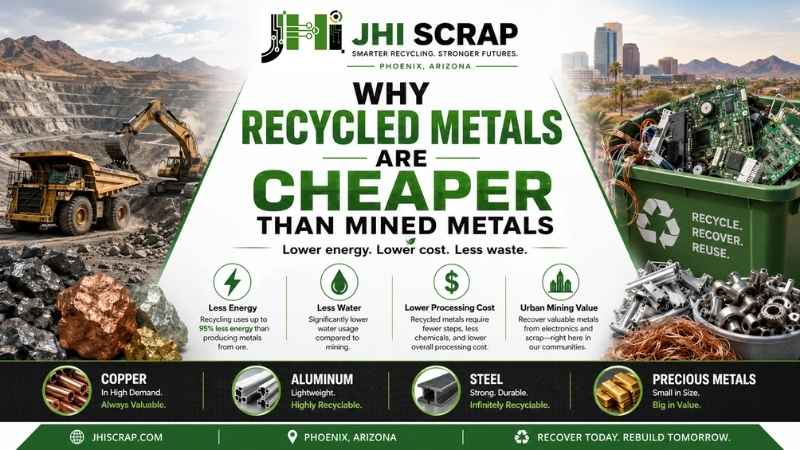
Why Recycled Metals Are Cheaper Than Mined Metals
If you’ve ever gotten a quote to recycle old electronics and wondered how the recycler makes money on what looks like a pile of junk, the answer comes down to one simple fact: pulling metal out of a used laptop is a lot cheaper than pulling it out of the ground.
That price gap is the whole reason electronics recycling exists as a business, and it’s worth understanding if you’re a Phoenix homeowner, renter, office manager, school administrator, or property manager trying to figure out what actually happens to your old gear after pickup. This isn’t a one-line fact. It’s an entire economic system, and once you see how it works, you’ll never look at a box of dead electronics the same way again.
The Short Answer
Mining a metal means digging up rock, crushing it, chemically separating the metal from the ore, and then refining it into something usable. Every one of those steps costs energy, water, labor, and heavy equipment. A copper mine, for example, might process a ton of rock to recover less than 20 pounds of usable copper. The rest is waste rock, called tailings, that has to be stored, managed, and often remains an environmental liability for decades.
Recycling skips almost all of that. The metal has already been refined once, somewhere back down the supply chain. Recovering it from an old device just means separating it out and melting it down, not starting from raw rock all over again. That difference in starting point is the entire reason recycled metal costs less to produce than mined metal, and it shows up clearly in the numbers for nearly every metal used in modern electronics.
Why Ore Is Expensive and Scrap Is Cheap
It helps to picture the two supply chains side by side. Mined metal starts as ore, which is rock that contains a small, often tiny, percentage of the target metal mixed in with everything else. Copper ore frequently runs below 1 percent copper by weight. Gold ore might contain a gram or two of gold per ton of rock. Getting that metal out means moving enormous volumes of material, using explosives and heavy machinery, then running the crushed rock through chemical or thermal processes that separate metal from waste.
Each of those steps eats energy. Digging and hauling rock takes diesel. Crushing and grinding takes electricity. Smelting takes enormous heat, often supplied by burning fossil fuels. Refining to a usable purity takes even more processing. By the time a pound of virgin metal reaches a manufacturer, it has absorbed the cost of every step in that chain, plus the cost of managing the waste left behind.
Scrap metal skips almost every one of those steps. A copper wire pulled from an old server has already been mined, smelted, and refined once. Recovering it means stripping insulation, sorting it from other materials, and melting it down, a process that uses a fraction of the energy and none of the excavation. That’s why scrap yards, electronics recyclers, and metal processors can pay for material that a mining company would spend millions of dollars to produce from raw rock.
Aluminum: The Clearest Example
Aluminum is the poster child for recycling economics, and the numbers back it up in a big way. Making new aluminum from bauxite ore requires running the Hall-Héroult smelting process, which uses a massive amount of electricity to strip oxygen away from aluminum atoms. Primary aluminum production has been estimated to require somewhere around 130 to 190 gigajoules of energy per tonne, depending on the region and energy mix involved.
Recycled aluminum skips that electrochemical step entirely, since the metal only needs to be re-melted, not chemically separated from ore all over again. Melting scrap aluminum typically requires somewhere around 5 to 10 percent of the energy needed for primary production, which lines up with the commonly cited figure that recycling aluminum saves roughly 90 to 95 percent of the energy used to make it from scratch.
That energy gap translates directly into cost. Recycled aluminum production has been estimated at a fraction of the price per pound compared to primary aluminum smelted from bauxite, since energy is one of the largest line items in metal production. It also translates into equipment costs. Recycled aluminum requires only a fraction of the capital equipment investment compared to a primary smelter, since there’s no need for the massive electrolysis cells that primary production requires.
This is why aluminum cans, window frames, siding, and even the aluminum housings inside old laptops and desktops are some of the most consistently valuable scrap categories out there. There’s very little standing between “old part” and “usable metal” once it’s separated and cleaned.
Copper: Almost as Dramatic
Copper tells a similar story, though the numbers run a bit different. Mining copper ore involves blasting through rock, moving enormous volumes of low-grade material, and running energy-heavy smelting and refining operations. Because copper ore grades are so low, mining and mineral processing alone can account for the majority of the total energy used in primary copper production.
Recycled copper, by contrast, starts from material that’s already close to pure metal. Most industry estimates put the energy savings from recycling copper somewhere between 85 and 90 percent compared to mining and refining it fresh. Some sources go further, citing figures as high as 90 percent depending on the grade and cleanliness of the scrap being processed.
Copper also holds its value exceptionally well after recycling, which is unusual among metals. Unlike some materials that lose quality every time they’re reprocessed, copper doesn’t degrade when it’s melted down and reused. That means recycled copper can sell for close to the same price as newly mined copper, often in the range of 90 to 95 percent of the value, even though it cost far less energy and money to produce.
That’s a big part of why old wiring, plumbing, motor windings, and the copper components inside computers, monitors, and industrial equipment are worth real money at a scrap yard. Every pound of copper recovered from old equipment is a pound that never has to come out of a mountainside in Chile, Arizona, or anywhere else.
Steel: The Quiet Workhorse
Steel doesn’t get the same headline attention as aluminum, copper, or gold, but it’s the highest-volume recycled metal on earth by a wide margin, and the energy savings are still substantial. Producing steel from recycled scrap using an electric arc furnace typically uses somewhere between 60 and 75 percent less energy than producing it from virgin iron ore through a blast furnace.
Each ton of recycled steel is estimated to save well over a thousand pounds of iron ore, along with hundreds of pounds of coal and limestone that would otherwise be needed to run a traditional blast furnace. Steel doesn’t lose its structural properties when recycled, so it can be melted down and reformed indefinitely without any meaningful loss of quality, similar to aluminum and copper.
Inside old electronics and office equipment, steel shows up in chassis, brackets, server racks, filing cabinets, and countless structural components. It’s rarely the flashy part of a recycling load, but it’s often the heaviest, and it adds up fast for offices doing a full equipment cleanout.
The Hidden Gold Mine Inside Your Old Electronics
Here’s the part most people don’t expect, and it’s genuinely one of the most interesting facts in the entire recycling industry. A printed circuit board, the kind found in old computers, phones, and servers, can carry a far higher concentration of gold, silver, and palladium than the ore dug out of an actual gold mine.
Research on the topic consistently finds that the metal content of a printed circuit board can run ten to a hundred times higher, gram for gram, than a conventionally mined ore body. Traditional gold ore often yields somewhere around one to two grams of gold per ton of rock. Estimates for circuit board material range enormously depending on the device type and board quality, but figures well into the tens or even hundreds of grams per ton are cited across multiple industry and academic sources.
One frequently cited estimate suggests that recycling a ton of mobile phones alone could recover roughly 130 kilograms of copper, 3.5 kilograms of silver, and about a third of a kilogram of gold. That’s not a typo, and it’s not a rounding error. Your retired office computers, old cell phones, and decommissioned servers are, quite literally, a richer source of gold than most active mines on earth, ounce for ounce of raw material processed.
This is what the recycling industry calls urban mining: recovering valuable metals from waste products instead of digging new holes in the ground. It’s a phrase worth remembering, because it reframes the entire conversation. A stack of dead laptops isn’t trash waiting for a landfill. It’s a concentrated ore body that happens to be sitting in a supply closet instead of underground.
This is also exactly why a responsible IT asset disposition process matters so much for businesses. Devices that get shredded whole and landfilled without proper recovery take that recoverable value with them, permanently, along with any data still sitting on the drives.
Rare Earths and the Metals Nobody Talks About
Gold and copper get the attention, but modern electronics are packed with dozens of other elements in smaller quantities, including rare earth elements used in speakers, hard drive magnets, and camera components, along with metals like palladium, tin, and various specialty alloys. A single circuit board has been estimated to contain up to sixty different chemical elements in some combination.
Most of these materials are mined in a handful of countries, which creates real supply chain risk for manufacturers who depend on them. Recovering rare earths and specialty metals from retired electronics, rather than relying entirely on new mining, is increasingly viewed as a way to reduce that dependency and stabilize supply for industries that need these materials to keep building new technology.
This is one of the less obvious reasons electronics recycling matters beyond the immediate environmental angle. Every properly processed circuit board is a small contribution toward a domestic, recoverable supply of materials that would otherwise depend entirely on mining operations halfway around the world.
The Environmental Math Behind the Price Tag
The cost savings and the environmental savings aren’t two separate stories. They’re the same story told from different angles, because energy use is the common thread running through both.
Every gigajoule of energy skipped by recycling instead of mining is also a gigajoule of fuel or grid electricity that didn’t get burned, which means fewer greenhouse gas emissions. Global primary aluminum production has been estimated at somewhere around 15 tonnes of CO2 equivalent per tonne of metal produced, cradle to gate. Recycled aluminum, by comparison, has been estimated at well under a single tonne of CO2 equivalent per tonne of metal, a reduction in the range of 90 percent or more depending on region and energy mix.
Copper follows a similar pattern. Mining and refining a single tonne of new copper has been estimated to generate somewhere around four to five tonnes of CO2, while recycled copper production generates a small fraction of that. Steel recycling through an electric arc furnace has been estimated to cut CO2 emissions by somewhere around 58 percent compared to producing steel from virgin iron ore through a traditional blast furnace.
Water tells a similar story. Primary metal refining, especially for steel, tends to be a water-intensive process, since cooling, cleaning, and chemical processing all draw heavily on water supplies. Recycled metal production has been estimated to use somewhere around 40 to 50 percent less water than primary production for some metals, which matters a great deal in a desert region like Phoenix and Maricopa County, where water availability is a genuine long-term planning concern, not an abstract talking point.
Land disturbance is the piece people think about least, but it might be the most permanent. A mine doesn’t just disappear when the ore runs out. Tailings, the crushed waste rock left over after extraction, have to be stored somewhere, often in massive impoundments that require monitoring for decades after a mine closes. Recycling facilities process material on a fraction of the land footprint and don’t leave behind that same long-term legacy.
None of this is meant to suggest mining should stop. The world still needs newly mined metal, and it will for a long time. But every pound of copper, aluminum, or gold recovered from old electronics is a pound that doesn’t have to come out of the ground, with all the energy, water, land, and emissions that would have required. That’s the real weight behind the phrase “urban mining,” and it’s why the economics and the environmental case point in exactly the same direction.
Beyond Electronics: Surplus Equipment and Component Recovery
Metal recovery from consumer electronics is only part of the picture. A lot of the same economics apply to industrial and commercial surplus, which is where things like retired test equipment, excess inventory, and surface-mount components come in.
Used test equipment, oscilloscopes, spectrum analyzers, multimeters, and similar gear, often has resale value that goes well beyond scrap metal recovery, since working or repairable units can be refurbished and resold rather than broken down. That’s a different kind of value recovery than melting down a circuit board, but it runs on the same underlying logic: something that still has function or usable material shouldn’t be treated as landfill-bound waste just because it’s outdated.
The same applies to surface-mount components and integrated circuit chips pulled from decommissioned electronics or excess manufacturing inventory. A reel of unused SMD capacitors or a tray of IC chips sitting in a warehouse after a product line gets discontinued still has real value, both as reusable components and as a source of the same base and precious metals found in any circuit board. Businesses sitting on excess inventory or discontinued stock are often surprised to learn there’s a market for that material rather than a dumpster.
This is part of why a recycler that handles more than just “electronics recycling” in the narrow sense, one that also works with industrial surplus, test equipment, and component-level recovery, tends to be better positioned to get full value out of a cleanout. A single load might contain material worth recovering in three or four completely different ways: refurbishment, component resale, bulk metal recovery, and precious metal extraction. Sorting that out correctly is where experience matters.
Why This Cost Gap Matters Beyond the Environment
It’s easy to file “recycling saves energy” under feel-good facts and move on to the next thing. But for a business, school, or property owner clearing out old equipment, the economics matter in a very practical, bottom-line way.
It’s why legitimate recyclers can offer fair pricing instead of padding fees. When the raw material itself is cheaper to recover than to mine, there’s more room to run an honest, transparent operation instead of squeezing customers with surprise charges on pickup day. If a quote feels aggressive or vague, that’s worth questioning.
It’s why “recycling” claims should be verified, not assumed. A company that says it recycles but actually exports intact devices overseas, or dumps unsalable material in an unregulated site, isn’t capturing that value responsibly, and it’s putting data security and environmental compliance at risk in the process. Asking what actually happens to your devices after pickup is a completely fair question to put to any recycler, and a trustworthy one should have a clear answer.
It’s why volume and consistency matter for pricing. A single old laptop won’t move the needle much on its own. A school district clearing out a computer lab, a medical office retiring imaging equipment, or a business doing a full IT refresh is sitting on a meaningful quantity of recoverable copper, aluminum, steel, and precious metal, and that volume is part of what shapes a fair, itemized quote rather than a flat guess.
It’s why data security and material recovery aren’t in tension with each other. Some people assume a recycler has to choose between wiping data thoroughly and maximizing metal recovery. In practice, the two happen at different stages of the process and neither one slows the other down.
What Actually Happens After Pickup
Once devices are collected, they typically move through a few distinct stages before any metal gets recovered. Understanding this sequence helps answer the questions most people actually worry about: is my data safe, is this actually getting recycled, and is anything going to a landfill.
Step one is intake and sorting. Devices get logged, and anything that still holds data, hard drives, SSDs, phones, tablets, gets separated out immediately for secure handling before it ever touches a general processing stream.
Step two is data destruction. This is where drives get wiped or physically destroyed according to recognized data sanitization standards. The most widely referenced framework in the industry is NIST Special Publication 800-88, Guidelines for Media Sanitization, which defines methods like clearing, purging, and physical destruction based on how sensitive the data is. Reputable providers can issue a certificate of destruction documenting the method used and the date it happened, which matters a lot for healthcare offices, financial businesses, schools, and anyone else bound by compliance requirements.
Step three is material separation. With data-bearing components handled, devices get broken down into their component materials: ferrous metals, aluminum, copper wiring and windings, plastics, glass, and circuit boards. Each stream goes to a processor equipped to recover that specific material efficiently, since a facility built to melt aluminum isn’t the right setup for extracting precious metals from a circuit board.
Step four is recovery and refining. Circuit boards, connectors, and other precious-metal-bearing components go through specialized processes to recover gold, silver, palladium, and copper. Bulk metals like steel and aluminum get baled or shredded and sent to smelters that specialize in that specific material.
For Phoenix and Maricopa County businesses, understanding this sequence matters because it turns “trust me” into something you can actually verify. A recycler that can walk you through each of these steps, and back it up with documentation, is operating very differently from one that just says “we’ll take care of it.”
Arizona’s Rules on Electronics Disposal
One question that comes up constantly is whether it’s even legal to just toss old electronics in the regular trash. Arizona doesn’t have a single, comprehensive statewide e-waste law the way California does, which sometimes leads people to assume there are no rules at all. That’s not quite accurate.
Electronics contain materials like lead, mercury, and cadmium that fall under general hazardous waste rules enforced by the Arizona Department of Environmental Quality, and many municipalities, including Phoenix, prohibit electronics from going into curbside trash or blue recycling bins specifically because of those materials. Businesses in particular are generally expected to use licensed recyclers and keep records of how e-waste was handled, since commercial generators face more scrutiny than individual households.
The safest, simplest approach for a Phoenix homeowner or business is to treat old electronics the same way you’d treat anything else that shouldn’t go in a landfill: find a legitimate recycler, ask what happens to the material, and get it handled properly instead of guessing at what the rules technically allow. Understanding what actually counts as e-waste is a good first step before you start sorting a garage full of old equipment.
Common Questions From People Getting Quotes
Why do prices vary so much between recyclers? Because pricing depends on what’s actually being recovered and how efficiently a company can process it. A recycler with in-house sorting and direct relationships with smelters and refiners can typically offer better pricing than one that’s just acting as a middleman shipping material somewhere else for a cut.
Does it cost money to recycle electronics, or does the recycler pay me? It depends on the material. Equipment loaded with recoverable metal, like servers, networking gear, and bulk computer equipment, often has enough recoverable value that a legitimate recycler can offer a fair price or free pickup. Items with little to no recoverable material, or items that require special handling like CRT monitors with leaded glass, sometimes come with a processing fee instead. A trustworthy recycler should be able to explain that difference clearly rather than quoting a flat number for everything.
What happens if my data is still on the drive? It gets handled before any material recovery happens, using destruction methods appropriate to how sensitive the data is. This is standard practice, not an upsell, and you should expect documentation of the process for business equipment.
Is my old equipment actually recycled, or does it get shipped overseas and dumped? This is the single most important question to ask a recycler directly. Legitimate operations can describe exactly where materials go after processing. If a company is vague about it, that’s a signal worth paying attention to.
Does it matter if I bring in a mixed load of old cables, chargers, and random parts? Not really. Mixed loads get sorted during intake regardless. What matters more is letting the recycler know upfront if there’s anything sensitive on the equipment, like hard drives or old paperwork stored on a device, so it gets flagged for proper handling right away.
The Bottom Line
Mined metal starts from rock and needs a long, energy-hungry chain of extraction and refining to become usable. Recycled metal starts from something that’s already been through that process once, which is why it costs so much less to produce, and why a responsible recycler can pay a fair price for your old electronics instead of simply charging you to haul them away.
That’s the whole economic engine behind computer and electronics recycling: the metal was never junk sitting in a closet. It was always a resource waiting for someone to recover it the right way, safely, legally, and without cutting corners on your data in the process.
If you’ve got old computers, servers, networking equipment, or office electronics piling up in Phoenix or the surrounding Valley, JHI Scrap has been handling secure, responsible electronics recycling and industrial surplus recovery since 1980. Give the team a call for a straightforward, itemized quote on what your old equipment is actually worth, and what happens to it after it leaves your building.