
How Much E-Waste Does Arizona Generate Each Year?
Meta title: Arizona E-Waste Statistics: Annual Waste Estimate
Meta description: Arizona produces an estimated 176,000 tons of e-waste yearly. See the calculation, risks, and safe recycling steps in Phoenix.
Primary keyword: Arizona e-waste statistics
Slug: arizona-e-waste-statistics
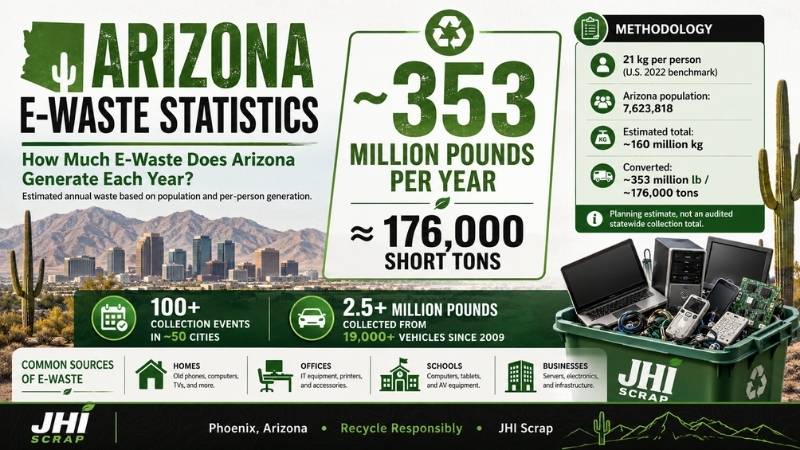
Arizona likely generates about 350 million pounds of e-waste each year. That equals roughly 176,000 short tons. It is a planning estimate, not an audited state total.
The estimate uses the latest comparable U.S. figure of 21 kilograms per person in 2022. It then applies Arizona’s July 2025 population estimate of 7,623,818. The math is simple. 7.62 million people times 21 kilograms equals about 160 million kilograms. That becomes about 353 million pounds, or 176,000 U.S. tons.
That number matters because old devices do not disappear. They sit in garages, offices, storage rooms, and back closets. In Phoenix, the Valley heat is no joke. A forgotten box of electronics can become a bigger problem fast.
The short answer: plan for Arizona to produce about 175,000 to 180,000 tons yearly. Use that range for planning, education, and local recycling decisions. Do not present it as a state-reported annual collection total.
How This Arizona E-Waste Estimate Works
Arizona does not publish one complete annual e-waste generation total. That is the honest starting point. Devices leave homes and businesses through many paths. Some are recycled. Some are resold. Some sit unused. Some go into regular trash.
The strongest public benchmark is national per-person generation data. The Global E-waste Monitor 2024 reports that the United States generated 7.2 billion kilograms in 2022. That works out to about 21 kilograms per person.
Arizona’s population has grown since 2022. So this post applies that per-person number to the current state estimate. It gives readers a useful, transparent scale. Think of it like estimating monsoon rain with a rain gauge nearby. It is not the whole storm map. Still, it tells you to bring an umbrella.
Input Value used
U.S. e-waste per person 21 kilograms in 2022
Arizona population 7,623,818 people, July 2025 estimate
Estimated annual e-waste 160 million kilograms
Converted total About 353 million pounds
U.S. short tons About 176,000 tons
The source years differ. That is why the result is an estimate. A state study with measured collection, reuse, disposal, and business flows would be more exact. Until then, transparent math beats a made-up “official” number.
What Counts as E-Waste?
E-waste means discarded electrical and electronic equipment. The common name is electronic waste. It includes much more than laptops and phones. If it needs a battery, a plug, or a circuit board, it may belong in this stream.
The Valley’s heat is no joke, especially for stored batteries. Keep damaged batteries away from metal items. Do not leave swollen batteries in a hot vehicle. Call a qualified recycler before moving anything that looks unsafe.
Common Arizona e-waste includes:
- Desktop computers, laptops, monitors, and tablets
- Smartphones, smart watches, routers, and modems
- Printers, copiers, scanners, and fax machines
- Servers, network switches, hard drives, and backup tapes
- Televisions, game consoles, speakers, and cameras
- Cables, chargers, circuit boards, and loose components
- Lithium-ion batteries, power supplies, and UPS battery packs
Some items need special handling. CRT televisions contain leaded glass. Batteries can create fire risks. Data devices may still hold passwords, photos, tax records, customer files, or patient information. One little drive can carry a whole lot of history.
Why Arizona’s E-Waste Keeps Growing
Arizona’s e-waste grows because the state keeps adding people, homes, offices, and devices. A new apartment may add a router, television, laptops, chargers, kitchen devices, and smart-home gear. A growing office adds computers, phones, screens, and network equipment.
Replacement cycles also move quickly. Phones can be traded every few years. Businesses replace computers on fixed schedules. Schools refresh Chromebooks. Medical offices upgrade scanners and workstations. The old devices often stay behind because disposal feels like one more chore.
In the Valley, the heat is no joke for stored electronics. A garage is not a long-term archive. Heat can shorten battery life. Dust fills ports and fans. A device that was easy to reuse may become harder to test later. That is why “I’ll handle it someday” can turn into a costly pile.
The problem is not just volume. Modern devices are lighter than older CRT screens. A truckload can contain less weight while holding more devices. Weight alone does not show data risk, battery risk, or material value.
Why 176,000 Tons Matters in Phoenix
A yearly estimate near 176,000 tons shows the scale of the local decision. Even if the real figure moves up or down, Arizona creates an enormous stream of retired equipment. One home cleanout seems small. One office refresh seems routine. Together, they form a supply chain that needs care.
In Phoenix, the Valley heat is no joke. Electronics should not become another desert storage problem. A hot garage full of boxes is not a recycling plan. It is a delayed decision with batteries, wires, and old hard drives inside.
The best outcome depends on the item. A working laptop may be reused after secure wiping. A damaged laptop may be dismantled for materials. A dead drive may need physical destruction. A television may need separate handling. Recycling is not one big blue bin. It is more like sorting a toolbox before a repair.
This is also a local business issue. Property managers clear tenant spaces. Offices move. Schools replace devices. Warehouses find obsolete controls. Hospitals retire equipment. Each group needs a clear chain of custody, especially when data lives on the device.
How Much Arizona E-Waste Gets Recycled?
No public source gives a complete, current Arizona recycling rate for all e-waste. That gap matters. Collection events, private recyclers, resale shops, scrap yards, and landfill routes do not report into one statewide dashboard.
Arizona has made real collection efforts. The Arizona Department of Environmental Quality reported that more than 100 collection events in about 50 cities had collected over 2.5 million pounds from more than 19,000 vehicles since 2009. Those events show demand. They do not measure every device generated statewide.
The Valley heat is no joke, and neither is incomplete reporting. A collection event can help a family clear a garage. It cannot tell us what happened to every office server or old phone statewide. That is why this article separates generation from documented collection.
For context, the 2024 global report found that only 22.3 percent of world e-waste was documented as formally collected and recycled in an environmentally sound way during 2022. Arizona should not assume its share is better without clear local reporting.
What Happens After You Recycle Electronics?
A responsible recycler starts with sorting, not shredding. The first question is whether an item can be reused. A working business laptop may have value. A damaged power supply may not. The process should match the item and your risk.
The Valley heat is no joke, so timely pickup matters. A clean office clearout is easier before devices sit through another summer. A normal process can look like this:
- Confirm the item list, pickup needs, and any special equipment.
- Record data-bearing devices and create transfer paperwork.
- Test equipment that may be reused or resold.
- Sanitize or destroy data-bearing media using the chosen method.
- Separate metals, circuit boards, plastics, glass, and batteries.
- Send materials through qualified downstream recovery channels.
- Provide reports or certificates when the project requires them.
Ask what happens after pickup. Ask if the recycler can identify its downstream partners. Ask what proof comes back for hard drives. Good answers should sound specific. Vague promises are a red flag.
Data Security Changes the Decision
A retired device can still expose a business or household. Deleting files is not always enough. Reformatting a drive may not remove every recoverable record. For some devices, secure wiping is suitable. For others, physical destruction is the safer choice.
In the Valley, the heat is no joke, but data loss is worse. A loose laptop from an office move can hold payroll files, login tokens, client documents, or saved browser passwords. That risk can survive years in a closet.
For a deeper look at methods and proof, read JHI’s guide to data destruction. It explains why security should be part of disposal planning, not an afterthought.
Businesses should request documentation that fits their risk. Useful records may include an asset list, signed transfer paperwork, a certificate of destruction, and a recycling summary. The right package depends on the job. A single household phone differs from a hospital workstation refresh.
Why Desert Heat Makes Storage a Poor Plan
Phoenix heat makes long-term device storage a bad bet. The Valley heat is no joke. High temperatures can stress batteries, plastics, and seals. Dust can cover vents and make devices harder to inspect or reuse.
A few safe habits help:
- Do not crush, puncture, or bend batteries.
- Keep swollen batteries away from papers, fabric, and metal objects.
- Do not pile loose batteries in drawers or bins.
- Store devices indoors until you arrange drop-off or pickup.
- Label business devices that may contain data before moving them.
- Separate televisions and CRT monitors from regular electronics.
The goal is not to scare anyone. It is to stop a small pile from becoming a messy project. A cleanout is easier when you sort devices early. Like sunscreen in July, a little prevention saves you later.
What Arizona Businesses Should Do During an IT Refresh
Businesses create e-waste in batches. A 25-person office refresh can leave laptops, docks, monitors, phones, cables, and drives all at once. A warehouse upgrade can add scanners, test equipment, switches, and battery backups. That is where a simple plan pays off.
The Valley heat is no joke. Do not let retired equipment sit beside active inventory. Create one controlled staging area. Limit access. Record serial numbers when needed. Then choose whether equipment should be reused, sold, wiped, or destroyed.
For larger projects, IT asset disposition gives a more structured path. It combines data handling, value recovery, reuse, and responsible recycling. It also helps a team show what happened after the equipment left.
A practical refresh checklist includes:
- Name one owner for the retirement project.
- List data-bearing assets before anyone moves them.
- Set reuse and destruction rules before pickup day.
- Ask for a written quote when fees may apply.
- Keep records that match your compliance needs.
- Schedule removal before storage becomes a bottleneck.
How to Choose an E-Waste Recycler in Phoenix
Choose a recycler by asking clear questions. The Valley heat is no joke, but neither is a vague quote. You want a company that can explain the process before your equipment leaves.
Start with these questions:
- What items do you accept, and which items have fees?
- Do you offer pickup, drop-off, or both?
- How do you handle hard drives, SSDs, and backup media?
- Can you provide destruction or recycling documentation?
- What happens to reusable equipment?
- Who processes materials after your facility?
- Do you handle batteries, CRTs, televisions, and large equipment separately?
Price matters, but it is not the full story. A free pickup that leaves you with no records can cost more later. Think of a recycler as the last handler in your device’s story. You should know who that handler is and what they do.
If you are comparing local options, JHI’s Phoenix e-waste guide can help you spot the right next step. It is useful for residents, offices, and anyone facing a mixed pile of electronics.
What Can Be Reused, Sold, or Recycled?
Not every old device belongs in the same box. Some equipment still has working life. Some items hold resale value. Others are ready for materials recovery. The Valley heat is no joke, so condition can change while equipment waits.
Working laptops, desktops, servers, switches, test equipment, and electronic components may have reuse value. Older equipment can still help another business or hobbyist. Broken items may still contain recoverable circuit boards, copper, aluminum, steel, glass, and plastics.
This is especially important for companies with surplus stock. A pallet of unused components is not always e-waste. It may be inventory with value. Before you recycle a large batch, ask whether it should be evaluated for resale or recovery.
JHI has worked in electronics recovery since 1980. Its electronics recycling service can help identify the practical path for retired devices, components, and surplus material. The right decision can reduce clutter and recover value at the same time.
A Better Local Plan for Arizona E-Waste
A better Arizona e-waste plan starts before a device dies. The Valley heat is no joke. Make a small retirement routine for homes, offices, schools, and properties. Keep a labeled bin. Store items indoors. Separate batteries. Mark devices that contain data.
For households, choose a recycler before the garage pile grows. For businesses, tie disposal to your refresh schedule. For property managers, add electronics to move-out and cleanout checklists. For schools, set a collection date before summer storage fills up.
The goal is not perfection. It is a repeatable habit. When a device reaches the end of its useful life, you should know the next step. That lowers stress, protects information, and keeps useful materials moving.
For a broader primer, see what e-waste is and how to recycle electronics in Phoenix. It is a helpful starting point when you need to sort a mixed collection.
Where Arizona’s E-Waste Comes From
Arizona’s e-waste comes from homes, offices, schools, hospitals, warehouses, and construction sites. The Valley heat is no joke. Each place replaces devices for a different reason.
Homes create a steady stream of phones, laptops, televisions, routers, chargers, printers, and small appliances. A kitchen drawer may hold five old phones. A garage may hold two monitors, a printer, and a box of mystery cords.
Businesses create larger batches. A company may replace thirty laptops at once. A retail chain may retire point-of-sale hardware. A warehouse may remove scanners, radios, controllers, and battery backups during an upgrade.
Schools and universities also have regular refresh cycles. Chromebooks, tablets, projectors, smart boards, and network gear all age out. The equipment may look small one by one. A district refresh can fill pallets quickly.
Healthcare settings need extra care. A retired workstation may hold patient information. A lab may have specialized instruments, printers, and connected devices. The recycling choice needs to match both the equipment and the records inside it.
Arizona’s growing technology and manufacturing base adds another layer. Test equipment, industrial controllers, circuit boards, sensors, and surplus components may not be household e-waste. Still, they need careful evaluation before disposal.
In the Valley, the heat is no joke for timing. A device pile grows faster after a move, refresh, or cleanout. The best time to plan disposal is before the replacement truck arrives.
It helps to sort by source. Keep household devices separate from business assets. Keep batteries apart from cables. Keep equipment with data away from general scrap. That small bit of order makes quotes, pickup, and documentation much easier.
The Valuable Materials Hiding Inside Old Devices
Old electronics contain useful materials, not just clutter. The Valley heat is no joke, but a hot storage room can still hold valuable metal and components. The value depends on the item, condition, quantity, and market.
Circuit boards may contain copper, gold, silver, palladium, and other metals. Cables can contain copper and aluminum. Computer cases hold steel and aluminum. Screens, batteries, and plastics need different recovery paths.
That is why careful sorting matters. Throwing every device into one bin is like mixing every tool in a dark drawer. You lose visibility. You make recovery harder. You can also create safety and data problems.
Reuse should come before recycling when it makes sense. A tested laptop can keep working. A functioning switch may help another office. A surplus component may solve a supply problem for someone else. That keeps value higher and avoids a new purchase.
Recycling still matters when reuse is not practical. A broken device can become a source of recovered materials. The goal is to send each item to its best next use. That is a smarter outcome than treating every old gadget as garbage.
The Valley heat is no joke for stored equipment. Conditions change quickly in dusty garages and uncooled spaces. If an item may have value, have it evaluated early. Waiting can reduce reuse options.
Arizona E-Waste Rules: What Residents and Businesses Should Know
Arizona e-waste rules are not one simple statewide checklist. The Valley heat is no joke, and neither are assumptions about disposal. Requirements can depend on the item, location, generator type, and waste condition.
For residents, the safest first step is usually to contact a qualified recycler. Ask about accepted items, drop-off rules, fees, batteries, televisions, and CRT monitors. City programs may also have special event rules or item limits.
For businesses, the picture can be more complex. Data security, contracts, industry rules, and internal policies can matter as much as waste handling. A healthcare provider, school, law firm, or financial business may need stronger records.
Do not treat this article as legal advice. It is a practical guide. If your organization has regulated data or specialized equipment, confirm the required process with your compliance lead and recycler before pickup.
The Valley heat is no joke, and a last-minute cleanout invites mistakes. Ask for the process in writing. Clarify fees before the truck arrives. Confirm what proof you will receive for data destruction or final recycling.
Keep basic records for business projects. Save the asset list, pickup date, transfer paperwork, quote, and final report. Those documents can answer a simple question later: where did our retired equipment go?
A 20-Minute Home E-Waste Sorting Plan
You can sort a home e-waste pile in about 20 minutes. The Valley heat is no joke, so move the project indoors if possible. You do not need a perfect inventory. You only need enough order to make a safe decision.
Start with three boxes or clear areas. Label them “data,” “batteries,” and “other electronics.” Place phones, laptops, tablets, external drives, and old computers in the data group. Place loose batteries and battery-powered devices in the battery group.
Put cables, chargers, keyboards, mice, printers, speakers, game consoles, and small appliances in the other group. Keep television sets and large monitors separate. They often need different transport and handling.
Next, look for damage. A swollen battery needs special care. Do not bend it. Do not toss it in a regular bin. Keep it away from heat, paper, and metal. Call a recycler for instructions if you are unsure.
For data devices, remove personal accounts when you can. Back up the files you need. Sign out of cloud services. Factory-reset a phone if it still works. These steps help, but they do not replace secure data handling for sensitive devices.
The Valley heat is no joke, so do not leave the sorted boxes in your car. Schedule the next step. A quick drop-off plan is better than a perfect pile that sits for six months.
If you are unsure about an item, take a photo and ask. A recycler can often identify the device from a label or model number. That is quicker than guessing, and it helps avoid wasted trips.
Why Reuse and Repair Still Matter
Reuse and repair reduce the next wave of e-waste. The Valley heat is no joke, but replacing a working device too early creates more material, more cost, and more cleanup. A smart retirement plan starts with a simple question: can this still serve someone?
A laptop with a weak battery may still work after repair. A desktop may need a new drive or memory. A monitor may be useful in a home office. A network switch may fit a smaller site. Condition and demand decide the answer.
Businesses should also separate usable equipment from true end-of-life material. A working device may have resale value. A refurbished unit may help a nonprofit, school, or smaller business. Responsible reuse also needs secure data removal.
Repair is not always worth the cost. Some devices are too old, damaged, or power-hungry. That is fine. The point is to decide deliberately. Reuse, resale, recycling, and destruction are different paths. Each solves a different problem.
The Valley heat is no joke for waiting. Test equipment while it is still in good condition. A device that works today may be harder to reuse after another summer in storage.
Special Items That Need Extra Planning
Some electronics need more than a standard pickup request. The Valley heat is no joke, and special items can create special handling needs. Tell the recycler about them before collection day.
CRT televisions and monitors need care because of their leaded glass. Large flat-screen televisions can be awkward to move and may have fees. Never assume a recycling site accepts every display for free.
Lithium-ion batteries deserve special attention. They can be found in phones, tools, laptops, e-bikes, power banks, and backup units. Do not tape over damage or hide a swollen battery inside a box of cables.
UPS battery packs and large battery systems may need a business-grade solution. Ask whether the recycler handles the exact battery chemistry and size. Weight, transport, and condition can all change the plan.
Lab equipment, medical devices, and industrial controls may hold sensitive data or specialized parts. They may also have resale value. An evaluation can prevent a useful asset from becoming scrap too soon.
Solar equipment is another growing category. Arizona has a large solar footprint. Inverters, monitoring hardware, and damaged panels should be discussed with a recycler that understands the material and local rules.
The Valley heat is no joke. Share a complete list upfront. A short call before pickup can prevent surprises, delays, and unsafe handling.
Schedule a Clear, Secure E-Waste Evaluation
If you have a home, office, school, or warehouse cleanout, start with a clear inventory. The Valley heat is no joke. You do not need to solve every detail alone. List the item types, note any hard drives or batteries, and ask about pickup or drop-off.
JHI Scrap serves Phoenix and Maricopa County from its Phoenix location. The company handles electronics recycling, IT asset disposition, industrial surplus, and component recovery. Its approach is built around clear evaluation, practical handling, and no-surprise communication.
Visit JHI Scrap to request a free evaluation or schedule a pickup. Call before visiting because public access is by appointment. A quick conversation now can keep a pile from becoming a bigger project later.
Frequently Asked Questions
Is 176,000 tons Arizona’s official annual e-waste total?
No. It is an estimate. It applies the 2022 U.S. per-person figure to Arizona’s 2025 population estimate. Arizona does not publish a complete audited statewide total for all e-waste routes.
How much e-waste does Arizona generate per person?
This estimate uses 21 kilograms per person yearly. That is about 46 pounds. The figure comes from U.S. 2022 e-waste data. Arizona’s actual per-person total may differ.
Can I put old electronics in my regular trash?
Do not assume regular trash is the best option. Electronics can hold data, batteries, metals, and materials needing special handling. Ask a qualified local recycler about your exact items.
Should I remove my hard drive before recycling?
It depends on your risk and the recycler’s process. Removing a drive can add control. It can also complicate the device’s reuse. Ask whether secure wiping or physical destruction is available, and request proof when needed.
Why do some electronics recyclers charge fees?
Some items cost money to handle safely. CRT displays, televisions, batteries, and certain appliances often need more labor and special processing. A good recycler explains fees before the job starts.
What should a Phoenix business do with old computers?
Create an asset list. Separate data-bearing equipment. Decide what can be reused or sold. Then choose a recycler that can document transfer, sanitization, destruction, and final recycling when your business needs records.
The Bottom Line
Arizona likely creates about 350 million pounds of e-waste each year. That is around 176,000 tons. The figure is a transparent estimate, not a state-reported total. Still, it makes the local stakes very clear.
The Valley heat is no joke, and old electronics do not improve while they wait. Sort the pile. Protect data. Separate batteries. Ask direct questions. Choose a recycler that explains where everything goes.
When you are ready, contact JHI Scrap for a free evaluation or pickup discussion. A responsible next step can protect your information, recover useful value, and keep more electronics out of the wrong waste stream.