
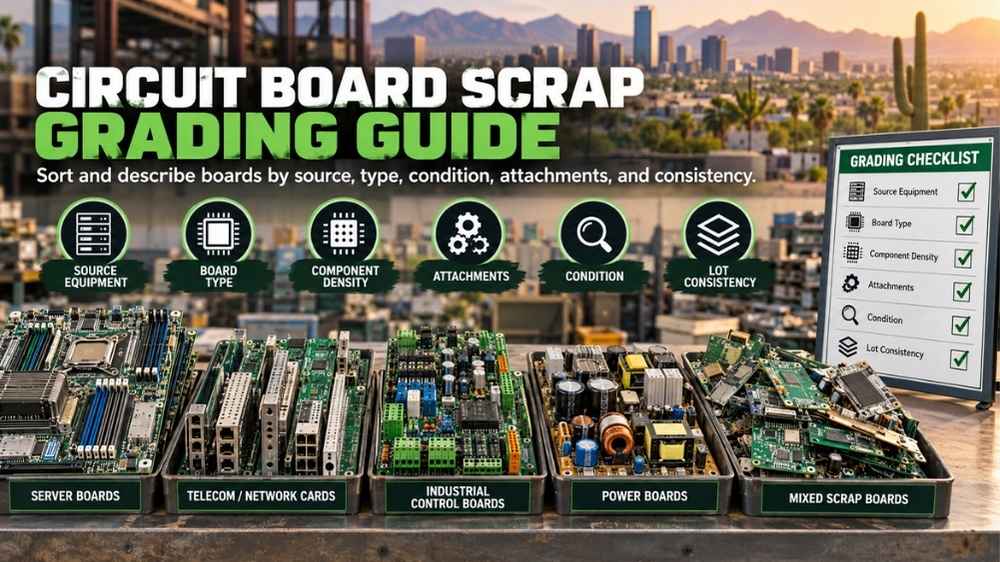
Circuit board scrap grading starts with source, board type, component density, condition, attachments, and lot consistency. A seller should separate clearly different board families before requesting an evaluation. The buyer should then define its own categories and settlement rules in writing.
There is no single universal circuit board grading chart used by every buyer. Terms such as high grade, mid grade, and low grade can mean different things. Use descriptive inventory language first. Let the receiving buyer confirm the commercial grade for that transaction.
What Is Circuit Board Scrap Grading?
Circuit board scrap grading is the process of separating boards into reasonably consistent commercial groups. The goal is not to guess exact precious-metal content. The goal is to give a buyer enough information to evaluate the lot and choose a processing route.
A printed circuit board supports and connects electronic components through conductive and insulating layers. Scrap loads may contain bare boards, populated assemblies, backplanes, controller boards, memory modules, cards, and damaged production material.
Different boards contain different component types, connectors, laminates, copper structures, solder, and attachments. Their reuse potential also varies. A working industrial board may deserve equipment-level review before material grading.
Grading therefore combines visual description, source information, condition, and buyer rules. It does not replace sampling, inspection, weighing, or other settlement methods named in the agreement.
Why Sellers Should Avoid Universal Grade Claims
One buyer may use three board categories. Another may use ten. The same label can represent different specifications. A seller who advertises “high grade” without a buyer definition may create an avoidable dispute.
Processor capabilities also differ. One facility may prefer boards with particular connectors. Another may price the load through a broader mixed category. Logistics, quantity, contamination, and market conditions can influence the commercial route.
Use facts that another person can verify. Record the original equipment source, visible board style, component density, connector type, attachments, quantity, condition, and whether the group is consistent. Photographs should show the full lot and representative details.
Ask the buyer to map each descriptive group to its commercial category. Retain that mapping with the offer. This keeps the seller’s inventory language separate from the buyer’s settlement language.
Start With Reuse Screening
A functional replacement board may have more value as equipment than as scrap. Industrial controls, test instruments, servers, telecom systems, and medical or laboratory equipment can contain identifiable assemblies. Some support long-lived installed systems.
Keep intact, identifiable boards separate from broken mixed scrap. Record manufacturer, assembly number, revision, serial number, source equipment, condition, and testing evidence. Do not call an assembly working from appearance alone.
Check ownership, warranty, customer-property, quality, and export restrictions. A rejected board may require special marking or destruction. A prototype may contain intellectual property. A board from leased equipment may not belong to the facility.
JHI’s surplus electronics service page lists rejected circuit boards and other business electronics. Sellers should confirm whether reuse review or scrap handling fits the specific lot.
The Main Visual Factors Buyers Review
Source equipment gives useful context. Boards from servers, telecom systems, industrial controls, consumer devices, power equipment, and appliances often have different layouts. Source information is more useful than a color-based guess.
Component density describes how much of the board carries integrated circuits, connectors, processors, memory, or other devices. Density alone does not establish metal content. Large low-profile components can differ from smaller connector-rich designs.
Connector style can matter. Edge fingers, pin connectors, backplane sockets, and removable modules may influence a buyer’s category. The buyer should define whether attached housings, shields, heat sinks, batteries, or cables belong in that category.
Condition also matters. Burned, wet, corroded, crushed, oily, or contaminated boards may require different handling. Tell the buyer about damage before transport. Do not bury problem material inside a clean group.
| Observation | What to record | Why it matters |
|---|---|---|
| Source | Server, telecom, industrial, consumer, power, unknown | Provides functional context |
| Board type | Populated, bare, backplane, card, module | Separates unlike material |
| Attachments | Heat sinks, housings, batteries, cables | Affects accepted weight and handling |
| Condition | Clean, damaged, burned, wet, corroded | Flags safety and settlement questions |
| Consistency | Single model, sorted family, mixed lot | Determines inspection confidence |
A Practical Descriptive Sorting Framework
Begin with bare and populated boards. Bare boards have no installed electronic components. Populated boards carry components and connectors. Do not mix manufacturing trim, laminate pieces, and complete assemblies unless the buyer accepts that combination.
Next separate obvious equipment families. Keep server and network boards away from appliance or power boards. Keep industrial controller assemblies away from loose consumer boards. Place memory, processor cards, and plug-in modules in distinct groups when quantities justify it.
Create a separate group for backplanes and connector-heavy assemblies. Create another for boards with substantial aluminum frames, steel covers, or heat sinks. The buyer may ask for attachments removed, but do not remove them until terms and safety are clear.
Use an unknown group for boards without reliable source information. Unknown does not mean worthless. It means the seller will not invent a description. Clear photographs can help the buyer decide whether further sorting is worthwhile.
Common Commercial Grade Labels
Buyers may use labels such as high-grade boards, medium-grade boards, low-grade boards, telecom boards, server boards, peripheral cards, power boards, or mixed boards. These are commercial categories, not universal scientific standards.
A connector-rich server card may enter one category with one buyer and another category elsewhere. A board with many components may still contain heavy low-value attachments. A small card may carry specialized connectors. Visual size cannot predict settlement alone.
Ask for a written category description. The description should explain included board types, required removal, excluded contamination, and how mixed material is treated. Photographs or reference samples can reduce ambiguity.
When a buyer changes a grade after receipt, request the applicable specification and evidence. A line-level reconciliation is easier to review than a broad statement that the load was downgraded.
High-Density Server and Telecom Boards
Server and telecom boards often receive focused review because they can carry dense components, sockets, memory connections, processors, and edge connectors. That description does not guarantee a particular grade or value.
Separate motherboards, line cards, controller cards, backplanes, and memory modules when practical. Keep model or source information. Remove storage devices only under the organization’s data policy. Some equipment may retain configurations or credentials.
Leave components intact unless the buyer’s written instructions say otherwise. Removing processors, memory, fingers, or connectors can change the category. It can also turn a consistent board group into an incomplete mixed lot.
Use wide and close photographs. Show both sides, connectors, labels, and attached hardware. State whether images represent the entire lot or only samples.
Industrial Control and Equipment Boards
Industrial boards may come from PLC racks, drives, machine controls, robotics, power systems, laboratory equipment, or production tools. Their assembly numbers and revisions may support reuse screening.
Keep modules intact during the first review. Record manufacturer, model, part number, revision, source machine, and condition. Note whether the item was removed from service, returned, rejected, or stored as a spare.
Custom fixtures and programmed controllers may contain proprietary information. Engineering and security should review memory, firmware, labels, and documentation. Do not send programs or drawings merely to support a scrap quote.
If the boards lack a reuse path, they can enter the buyer’s board categories. The seller should still preserve the source group. Industrial control boards should not disappear into an unlabeled mixed box.
Low-Density, Power, and Consumer Boards
Power supply boards, appliance controls, lighting boards, and some consumer assemblies can have fewer high-density components. They may also carry transformers, coils, large capacitors, steel, or aluminum attachments.
Do not assume the word low grade means unacceptable. It usually describes a buyer category. The material may still fit a responsible processing route. Acceptance and settlement depend on the buyer’s rules.
Separate boards with large transformers, batteries, or unusual components. Ask whether those items remain attached. Do not puncture capacitors, open transformers, or dismantle energized equipment.
Record contamination, oils, residue, heat damage, or water exposure. Safety and handling questions should be resolved before transport. A clean description protects both parties.
Bare Boards, Production Scrap, and Rejects
Bare printed circuit boards differ from populated assemblies. Manufacturing scrap may include panels, edge trim, drill waste, test coupons, rejected boards, and unused production remnants. Keep these categories separate.
Quality status matters. A rejected bare board may contain customer designs or controlled markings. The manufacturer decides whether sale, recycling, or destruction is permitted. The buyer should receive the approved restriction.
Record laminate type only when documentation supports it. Do not guess from board color. Note plating, panel size, copper layers, or surface finish only when reliable records are available and disclosure is authorized.
For recurring manufacturing surplus, JHI’s Phoenix excess inventory overview describes PCBs and other electronic categories. Transaction details still require direct confirmation.
Attachments That Can Affect Grading
Heat sinks, metal frames, fans, batteries, wires, housings, plastic trays, and steel brackets can add weight without belonging to the buyer’s board category. Some buyers accept them. Others require removal or apply a different settlement.
Do not strip attachments before asking. The labor may not improve the result. Removal can damage reusable assemblies, expose sharp edges, or create separate waste streams. The buyer may prefer the original configuration.
If removal is required, define who performs it and how removed material is handled. Follow workplace safety procedures. Avoid improvised cutting, breaking, heating, or chemical treatment.
Photograph representative attachments and estimate their prevalence. A buyer can then state whether the quote assumes clean boards, attached boards, or a mixed category.
What Not to Do With Circuit Board Scrap
Do not burn boards, cables, or components. Do not use open acid baths. Do not grind boards in an ordinary workspace. Informal recovery methods can expose workers and the environment to hazardous substances.
The EPA explains that electronics should be donated or recycled safely. Its electronics recycling guidance emphasizes conserving resources through proper routes.
Do not smash boards to fit more material into a container. Breakage can create sharp fragments, dust, lost labels, and mixed attachments. Use stable containers that protect workers and preserve inspection evidence.
Do not remove components selectively after receiving an offer. The buyer priced a stated configuration. Any material change should receive written approval.
How to Photograph a Board Lot
Take one overview photograph of every pallet, gaylord, tote, or box. Then capture representative boards from both sides. Include labels, connectors, attachments, damage, and any unusual items.
Use clear light and a neutral background. Avoid filters that change board color. Place a simple scale reference when size is unclear, but never cover original labels.
Name files using the group identifier. A sequence such as PCB-A-01 and PCB-A-02 connects the image with the inventory. State whether the boards shown represent the complete lot or a sample.
Protect sensitive information. Avoid customer names, controlled drawings, network details, serial lists, or employee information. Crop only after retaining an approved source image.
How to Build the Inventory
Use one row for each consistent board group. Record group ID, source equipment, board type, quantity or weight, condition, attachments, packaging, and notes. Mark every estimate as an estimate.
When serialized reuse candidates exist, list them separately. When many scrap boards share one source and condition, a grouped line may be sufficient. The buyer can request more detail when needed.
Keep the inventory version tied to the photographs and final packing list. If boards are added, removed, or stripped, create a revision. Do not overwrite the original approved version.
For chips or modules that become separate groups, JHI’s guide on whether computer chips can be recycled provides related context. Confirm the correct category before moving parts.
Weight, Tare, and Container Records
Circuit board transactions may use weight, count, lot price, or another basis. If weight matters, define gross weight, container tare, pallet tare, and net material weight. Identify which scale record controls settlement.
Label containers before weighing. Record container type and ID. A steel bin, wood pallet, cardboard box, and plastic tote have different tare. Do not rely on memory after unloading.
If the seller uses an estimate, state that clearly. The buyer may verify weight after receipt. The agreement should explain how differences are handled and whether the seller receives the weight record.
Keep non-board debris outside the board group. Packaging needed for safe transport should remain documented. The settlement should distinguish accepted packaging from material weight where applicable.
Sampling and Inspection Questions
Large mixed lots may require sampling or detailed inspection. Ask how samples are selected, how many containers are opened, and whether the sample represents the entire lot. A convenient top sample may not reflect deeper material.
Ask whether the buyer uses visual categories, component removal, laboratory analysis, processing yield, or another method. The method should match the written settlement terms. Do not assume an assay is included.
Preserve sample identifiers and photographs. If a category changes, the buyer should connect the change to evidence. Sellers should review material differences, not demand a grade unsupported by the agreed specification.
For high-value or highly mixed material, consider whether a supervised inspection is appropriate. The cost and benefit depend on lot size, risk, and commercial terms.
Packaging and Shipping
Use containers suited to the board size and weight. Avoid unstable piles. Protect sharp board edges. Do not overload boxes or create top-heavy pallets. Keep aisles and emergency access clear during staging.
Separate batteries and damaged battery-containing assemblies. Follow workplace and carrier rules. Tell the buyer about questionable items before pickup. Do not conceal them inside board scrap.
Provide pallet counts, dimensions, approximate weights, dock details, and access restrictions. Phoenix heat may affect battery-containing material and worker safety. Plan indoor staging when practical.
JHI’s business e-waste page describes its current service scope. Pickup eligibility, accepted material, and documentation should be confirmed for the actual load.
Reviewing a Circuit Board Offer
Confirm every included group and buyer category. Check whether the offer is firm, estimated, or subject to inspection. Identify excluded boards, attachments, containers, and contamination rules.
Confirm the settlement unit. It may be per lot, per pound, per item, or another method. Check whether the quote uses net weight and whether category changes can occur after receipt.
Ask about freight, packaging, loading, testing, sorting, refining, or other charges. Do not assume any deduction is included or excluded. The written offer controls the commercial arrangement.
Confirm payment requirements and the evidence supplied with final settlement. Keep the offer, inventory, transfer record, weight ticket, category reconciliation, invoice, and remittance together.
A Board Grading Checklist for Sellers
First, screen identifiable boards for reuse. Resolve ownership, quality, intellectual property, and data. Then separate bare boards, populated boards, modules, backplanes, server boards, telecom boards, industrial boards, power boards, and unknown boards.
Record source, condition, attachments, quantity, and consistency. Photograph each group. Mark estimates. Keep batteries, damaged items, and contamination separate. Avoid dismantling until the buyer gives written requirements.
Ask the buyer to define its categories. Confirm inspection, weight, tare, sampling, deductions, rejected material, logistics, and payment. Revise the inventory whenever the physical lot changes.
After transfer, reconcile shipped and received groups. Review every downgrade by lot ID. Close the transaction only after settlement and promised records are complete.
Source-Based Sorting Examples
Imagine a Phoenix manufacturer clears three production areas. One area contains server interface cards. Another contains drive-control boards. The third contains appliance-style power boards. Combining them would hide obvious differences in source and construction.
The team creates three source groups before making finer divisions. It then separates intact modules from loose boards. Boards with large frames enter an attachment subgroup. Damaged boards enter a disclosed exception group.
The seller does not label one group high grade. It sends photographs and inventory notes. The buyer maps each group to its own commercial categories. That approach prevents internal terminology from becoming an unsupported price promise.
This example is illustrative. It does not predict how JHI or another buyer will categorize a real load. The actual offer depends on inspection, quantity, condition, logistics, and written terms.
Triage for a Completely Mixed Board Lot
A legacy mixed lot may arrive without source records. Start with a visual triage table. Create areas for bare boards, connector cards, motherboards, backplanes, power boards, industrial modules, metal-framed assemblies, damaged material, and unknowns.
Do not aim for perfect identification on the first pass. The goal is to remove obvious differences. A second pass can separate consistent families when labels or construction make that practical.
Assign group IDs immediately. Photograph each group before repacking. Record whether quantities are counts, estimates, or weights. This preserves progress when several employees perform the work.
Set a time limit for researching unknown boards. Endless part-number searches can cost more than the potential benefit. Ask the buyer whether clear photos provide enough information for the next step.
Data and Intellectual Property on Boards
Circuit boards can carry removable storage, flash memory, programmable devices, security modules, or configuration data. Industrial controllers and network cards may reveal settings or credentials. Treat unknown memory as a review item.
The organization’s security and engineering teams decide whether media or programmed components must be sanitized, removed, destroyed, or retained. The grading team should not make that decision from appearance.
Board labels can also reveal customers, programs, internal part numbers, prototypes, or controlled designs. Photographs intended for buyers should disclose only authorized information. Keep unedited source images under appropriate access controls.
If removing a memory component changes the board configuration, tell the buyer. The existing offer may no longer apply. Security requirements come first, but commercial changes still need documentation.
Quality Status and Traceability
Manufacturing boards can be new surplus, field returns, process rejects, engineering samples, repair cores, or destructive-test remnants. These conditions are not interchangeable. Quality status should accompany the group.
Record the actual status from approved records. Do not remove reject markings or imply a failed board is unused. Customer returns may require warranty, ownership, or safety review before disposition.
Traceability can include assembly number, revision, lot, work order, source line, and inspection history. Share only authorized fields. A scrap buyer may not need controlled production documents.
When records are missing, state that limitation. Honest uncertainty lets the buyer choose a scrap category. Fabricated provenance can create serious commercial and compliance risk.
Container-Level Quality Checks
Before sealing a container, inspect the top, middle, and bottom layers when safe. Confirm that the group description remains accurate. Look for batteries, loose metal, trash, liquids, glass, and unrelated equipment.
Record the container ID, board group, packing date, approximate quantity or weight, and inspector. Use stable packaging. Avoid excessive pressure that breaks boards or damages connectors.
If a container holds a permitted mix, list the mix. Do not label it as one clean category. A representative photograph should show variation, not only the best boards.
Container checks reduce surprises at receiving. They also help the seller investigate a later downgrade. The record shows what staff observed before transfer.
Receiving and Grade Reconciliation
The receiving report should list each group ID and assigned buyer category. If the category matches the offer, the line can close. If it changes, the buyer should explain the observed difference.
A useful downgrade record includes photographs, sample notes, attachment percentages, contamination, or condition evidence. The seller can compare that evidence with its outbound record.
Quantity and grade questions should remain separate. A group can arrive at the correct weight but receive a different category. Another group can keep its category but have a weight variance.
Resolve discrepancies before final invoice approval when possible. Keep the final reconciliation with the offer, transfer document, weight records, settlement, and payment.
Building a Recurring Board-Scrap Program
Facilities that generate boards regularly should define collection categories with the buyer. Post clear container labels. Train staff to keep batteries, housings, loose metal, and ordinary trash outside board bins.
Manufacturing teams should identify rejects at the source. IT teams should flag data-bearing assemblies. Engineering should protect prototypes and service spares. The program works only when responsibilities are clear.
Review categories after each settlement. If one bin is repeatedly downgraded, inspect the sorting instructions. A label may be unclear, or the source stream may have changed.
Recurring reviews also reveal volume trends. The business can adjust container sizes, pickup planning, and internal controls without promising future market value.
Questions to Ask Before Accepting a Grade Chart
Ask whether the chart applies to your location and transaction date. Confirm whether photographs are examples or binding specifications. Ask how attachments, damage, contamination, and mixed boards affect the result.
Confirm whether the chart assumes intact boards. Ask whether removing processors, memory, fingers, heat sinks, or housings changes the category. Do not infer permission to dismantle.
Ask how the buyer handles boards that fall between categories. Confirm the inspection and appeal process. Request group-level reporting when the lot is large enough to justify it.
Finally, ask what records accompany settlement. The best grade chart is still incomplete without counts, weights, deductions, dates, and payment terms.
Training Employees to Sort Boards
Give employees photographs and plain descriptions of approved groups. Explain which items never enter board containers. Batteries, liquids, loose glass, trash, and unknown hazardous material need separate review.
Teach staff to preserve labels and avoid unnecessary dismantling. Provide a hold bin for uncertain boards. A safe hold path is better than forcing an employee to guess.
Audit containers periodically. Correct the instructions when the same mistake repeats. The source department may have changed equipment, making the old examples incomplete.
Keep training focused on observable facts. Employees do not need to estimate precious-metal content. They need to recognize source families, attachments, damage, and exceptions.
Final Release Review
Before pickup, compare every container with the final inventory. Confirm labels, photographs, quantity basis, condition, attachments, and safety flags. Remove hold items from the shipping area.
Confirm the buyer category assumptions and accepted configuration. Verify whether pallets, boxes, or totes require tare records. Make sure the transfer document lists every group ID.
Name one onsite decision-maker. Unexpected boards should not enter the load without approval. Record any last-minute change as a revision.
This final review protects the seller’s evidence. It also gives the receiver a cleaner, more predictable load.
Conclusion
Circuit board scrap grading is a communication system, not a universal chart. Sellers should describe source, board type, condition, attachments, and consistency. Buyers should define the commercial category and settlement method.
Good sorting prevents reusable assemblies from disappearing into scrap. It also keeps batteries, contamination, low-density boards, and clean connector-rich boards from becoming one uncertain load.
Use accurate records, safe handling, and written terms. That approach supports a clearer evaluation without inventing metal content, grade, price, or recovery.
Frequently Asked Questions
Is there one universal circuit board scrap grading system?
No. Buyer and processor categories vary. Ask for the written specification used for your transaction.
What information helps grade a circuit board lot?
Source equipment, board type, component density, connectors, attachments, condition, quantity, and consistency help evaluation.
Should I remove heat sinks before requesting a quote?
Ask first. Removal may change the category, add labor, damage boards, or create another material stream.
Are all server boards considered high grade?
No. Source alone does not guarantee a category. Configuration, attachments, condition, and buyer rules matter.
Can bare circuit boards be mixed with populated boards?
Keep them separate unless the buyer specifically accepts a mixed category.
Should working industrial boards be sold as scrap?
Screen identifiable, permitted assemblies for reuse before assigning them to a scrap group.
How should damaged or burned boards be handled?
Separate and disclose them. Confirm safe acceptance and transport requirements before moving the material.
Does sorting guarantee a better price?
No. Sorting improves clarity, but demand, processing, quantity, condition, logistics, and market terms still matter.
Need an evaluation for circuit board material?
Share clear group photos, source information, approximate quantities, and condition notes with JHI.