
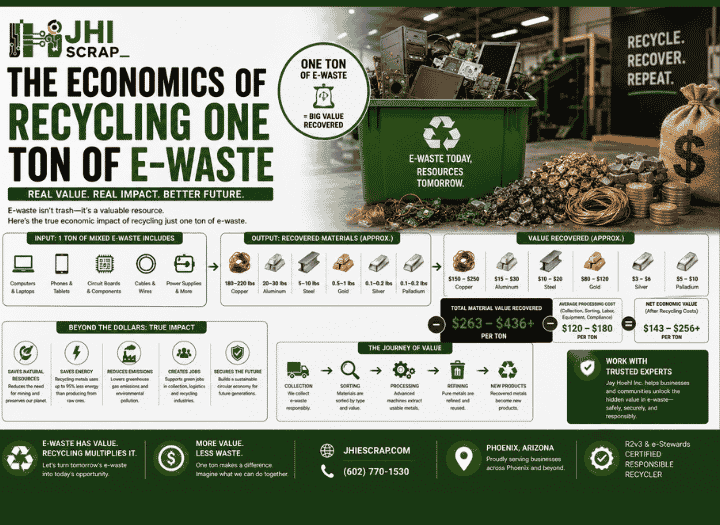
One ton of e-waste can hold real value. It can also lose money.
That answer may sound frustrating. Yet it is the honest starting point. A ton of newer laptops is not equal to a ton of printers. Clean circuit boards differ from mixed office junk. Working devices may earn resale income. Broken screens may carry fees.
The economics depend on what arrives, what still works, and what needs special handling. Labor, freight, data destruction, batteries, and market prices also matter. Think of the load as a grocery cart. Weight tells you how heavy it is. The contents tell you what it is worth.
For a Phoenix business, the best result often starts before pickup. A clear inventory helps a recycler plan labor and transport. Separating reusable equipment can protect resale value. Removing unknown trash reduces surprise charges. Good records also make the project easier to defend later.
This guide breaks down one ton, or 2,000 pounds, of e-waste. It explains revenue, costs, risks, and quote factors. It also shows why a recycler may pay for one load and charge for another.
What Does One Ton of E-Waste Mean?
One ton of e-waste means 2,000 pounds of discarded electrical or electronic products. The label covers many very different items.
A load may contain laptops, servers, switches, phones, and circuit boards. Another may hold televisions, printers, cables, batteries, and small appliances. Both loads weigh one ton. Their economics can sit miles apart.
The broad definition matters. E-waste includes products with a plug or battery. It covers office devices, consumer electronics, tools, and many embedded systems. The electronic waste definition gives useful background on this global material stream.
Weight remains important because freight and labor follow weight. Yet value follows composition. Three questions matter first:
- How much equipment can be tested and reused?
- Which metals and components can be recovered?
- Which items create labor, safety, or downstream costs?
A recycler cannot answer those questions from total weight alone. Photos, model lists, pallet counts, and working status help. A short inventory can turn a blind estimate into a useful quote.
Phoenix adds another practical issue. Electronics may sit in hot storage rooms or outdoor containers. Desert heat can swell batteries and damage screens. Dust can hide labels and slow testing. As locals know, an ounce of prevention is worth a pound of cure.
The Short Answer: Is One Ton of E-Waste Profitable?
One ton of e-waste is profitable only when recoverable value exceeds every handling cost. Those costs begin well before metal recovery.
Gross value may come from reusable devices, parts, circuit boards, copper, aluminum, steel, and precious metals. Net value subtracts collection, sorting, testing, data work, dismantling, packaging, freight, and downstream charges.
The basic model looks simple:
Net value = reuse income + material income – total processing costs
The hard part sits inside each term. Reuse income changes by model, age, condition, and demand. Material income changes with composition and commodity markets. Processing costs change with labor, distance, volume, and risk.
A clean batch of business laptops may produce positive value. Many units may still work. Their parts may also sell. A mixed load of old televisions and printers may produce negative value. Glass, plastics, toner, and damaged batteries can be expensive.
This is why a responsible recycler avoids a blanket promise. “Every ton pays cash” is not a serious rule. Neither is “all recycling must cost money.” The load decides.
The wider market supports that point. The Global E-waste Monitor 2024 reported $91 billion in metals within 2022 e-waste. Yet much of that value was not recovered. Collection gaps, processing costs, and product design stood in the way.
What Is Inside a Typical Ton?
A typical ton contains metals, plastics, glass, boards, cables, batteries, and reusable products. The exact blend controls the outcome.
There is no universal “average ton” for a local recycler. A school refresh differs from a data center project. A household collection differs from a factory cleanout. Even two office loads can vary sharply.
Still, most loads contain several economic groups.
Reusable Devices
Reusable devices can create the highest value per pound. They include working laptops, desktops, servers, network gear, phones, and test equipment.
Reuse keeps a complete product working. That usually preserves more value than shredding it. A working laptop has a processor, memory, screen, battery, and case. Sold together, those parts may serve another user. Shredded, they become mixed materials with added processing needs.
Age matters. Demand drops when equipment cannot run supported software. Cosmetic damage also matters. Missing chargers, locked accounts, and bad batteries can reduce value.
Parts and Components
Parts recovery sits between reuse and raw material recycling. Memory, processors, power supplies, drives, and network cards may hold value.
Testing adds labor. Inventory also needs accurate labels. A tray of identified processors is easier to market than a mixed box. The same rule applies to industrial boards and specialized components.
Some companies also hold unused electronic stock. That material may belong in a surplus electronics evaluation before recycling. New old stock can have more value as inventory than scrap.
Ferrous and Base Metals
Steel, aluminum, and copper often provide steady material income. They also make up substantial weight.
Steel cases may be easy to separate. Aluminum appears in heat sinks and frames. Copper appears in wires, motors, transformers, and boards. Clean separation usually improves grade and price.
However, base metals rarely tell the whole story. A heavy steel device may add pounds without adding much margin. It still requires lifting, sorting, storage, and transport.
Circuit Boards and Precious Metals
Circuit boards can contain copper, gold, silver, palladium, and other metals. Board grade changes recovery value.
High-grade server and telecom boards differ from low-grade appliance boards. Connector density, component type, contamination, and downstream terms matter. The visible gold color does not reveal the final payout.
Precious metals occur in small concentrations. Recovery needs specialized systems. Local recyclers often consolidate boards for qualified downstream processors. Payment may follow an agreed grade or an assay.
Plastics, Glass, and Low-Value Material
Plastics and glass can add cost. Mixed polymers may have weak markets. Screens may need special handling. Foam, wood, paper, and ordinary trash can lower the useful yield.
These fractions behave like passengers without tickets. They take space and fuel. They may bring little income. A cleaner load usually performs better.
Where the Revenue Comes From
Revenue comes from reuse, resale, parts harvesting, and recovered commodities. The order matters.
The most valuable route should be considered first. A useful hierarchy is:
- Redeploy the device inside the organization.
- Refurbish and resell complete equipment.
- Recover working parts.
- Separate material grades.
- Send residuals to approved processors.
This hierarchy protects value. It also reduces waste. Yet data security and client policy can limit reuse. Some drives must be sanitized. Others may require physical destruction.
Reuse and Resale Income
Reuse income depends on market demand, not original purchase price. A server that cost thousands may have little demand today. A modest laptop may still sell quickly.
Buyers consider model, processor, memory, storage, cosmetic condition, and battery health. They also check locks and licenses. Complete units generally outperform incomplete ones.
Timing matters too. Devices lose value during long storage. A three-month delay can erase part of the resale return. In Phoenix, heat can speed battery damage. Storing retired devices forever is like leaving ice in the sun.
Parts Income
Parts income can rescue value from incomplete equipment. Good memory, processors, screens, and power supplies may remain useful.
The recycler must test, grade, record, store, and sell each part. Returns and warranties can also reduce margin. A part with a $30 sale price does not create $30 in profit.
Commodity Income
Commodity income comes from separated metals and board grades. Quotes often track market conditions.
Copper usually earns more per pound than steel. High-grade boards often earn more than mixed low-grade boards. Clean aluminum can beat contaminated aluminum. Better sorting can improve settlement.
Commodity prices move. A recycler may use current published indexes or downstream schedules. The settlement may also include freight, minimum quantities, and recovery deductions.
Service Income
Some recycling projects include paid services. Pickup, packing, inventory, data erasure, drive destruction, and reporting take real work.
A service fee does not mean the materials have no value. It may cover costs that commodity income cannot. A transparent quote should show that relationship clearly.
The Full Cost Stack Behind One Ton
The full cost stack includes every step from collection through final settlement. Ignoring one step can turn a promising load into a loss.
Pickup and Transportation
Transportation depends on distance, truck time, fuel, loading, and equipment. Stairs, limited docks, and scattered rooms add time.
One packed pallet is simpler than loose devices across five floors. A scheduled Phoenix pickup may be efficient. A rush call across Maricopa County may cost more.
Freight also continues after local sorting. Boards, metals, batteries, and screens may travel to different processors. Each stream needs suitable packaging.
Receiving and Weighing
Receiving includes unloading, counting, weighing, labeling, and project setup. Good chain-of-custody records begin here.
Mixed loads take longer. Unknown containers may need inspection. Leaking batteries or broken screens can stop normal handling.
Sorting and Testing
Sorting decides the best path for each item. Testing determines whether reuse is realistic.
Workers may check power, ports, screens, batteries, drives, and locks. They may record serial numbers. Specialized equipment may need trained staff.
Testing everything is not always economic. Low-value devices may cost more to test than they can return. A recycler may sample or set age limits.
Data Security
Data security adds labor, software, equipment, records, and quality checks. It can also protect the client from a costly mistake.
Data-bearing assets include computers, servers, phones, drives, and network equipment. Secure handling should match the risk. Software sanitization may preserve reuse value. Physical destruction may remove that option.
Businesses should define their required method before pickup. The importance of data destruction explains why disposal and information security must work together.
Dismantling and Separation
Dismantling removes batteries, boards, drives, wires, metals, and other fractions. More separation can improve grades. It also consumes labor.
The recycler must choose an economic stopping point. Removing every tiny screw may not pay. Separating a valuable board or battery usually matters more.
Safety and Compliance
Safety costs include training, protective equipment, fire controls, ventilation, containers, and insurance. Lithium batteries deserve special attention.
Damaged batteries can heat, vent, or burn. They should not be crushed with ordinary material. Terminals may need protection. Swollen packs may need isolation.
Compliance also requires suitable downstream partners. Records may include weights, certificates, shipping papers, and destruction reports. These are not glamorous tasks. They are part of responsible service.
Downstream Processing and Residual Fees
Some fractions earn money. Others create charges. A downstream processor may charge for screens, lamps, damaged batteries, mixed plastics, or contaminated loads.
Residual disposal also matters. Not every ounce becomes a saleable product. Responsible processing pays for the hard fractions. It does not hide them.
Overhead and Market Risk
Facilities need rent, utilities, equipment, maintenance, software, staff, and insurance. Inventory also ties up cash and space.
Market risk enters when prices fall before material sells. Reuse inventory can age. Commodity lots may miss minimum grades. Returns can reduce resale income.
A sound quote includes room for these risks. A reckless quote may look better today. It can fail on pickup day.
A Practical One-Ton Economic Model
A practical model separates the ton into value groups and cost groups. It uses ranges, not fake precision.
The following framework is illustrative. It is not a current scrap quote. Actual results require inspection and current market terms.
Step 1: Describe the Input
Start with pounds by category. For example:
- Reusable computers and network equipment
- Nonworking computers and servers
- Circuit boards and components
- Cables and power supplies
- Printers and low-grade peripherals
- Screens, batteries, and special items
- Packaging and unrelated material
Record working status when known. Note missing parts and data-bearing devices. Include photos of labels and pallets.
Step 2: Estimate Gross Recovery
Estimate income by route. Keep reuse, parts, and commodities separate.
For reuse, estimate the tested saleable quantity. Apply expected sale prices. Then subtract selling fees, returns, and preparation.
For materials, estimate pounds by grade. Apply current downstream prices. Then subtract freight and settlement deductions.
For service work, identify client-paid tasks. These may include pickup, packing, inventory, or destruction.
Step 3: Estimate Direct Costs
List direct hours and outside charges. Include:
- Truck and crew time
- Receiving and sorting labor
- Testing and repair labor
- Data sanitization or destruction
- Dismantling and packaging
- Downstream fees
- Freight to final processors
Use realistic productivity. A perfect spreadsheet cannot make a slow process fast.
Step 4: Add Overhead and Risk
Add facility overhead, equipment use, insurance, administration, and market risk. Include a reserve for returns or rejected material.
This step keeps the model honest. A project can show a positive gross spread while losing money after overhead.
Step 5: Calculate the Client Settlement
The final client result may take several forms:
- A payment for valuable equipment
- A free pickup with no payment
- A service fee after commodity credits
- A revenue-share settlement after resale
- A blended quote with fixed and variable items
The best format depends on uncertainty. A fixed quote works when the inventory is clear. Revenue share may fit resale-heavy projects. Weight-based settlement may fit graded scrap.
Three One-Ton Scenarios
Three scenarios show why the same weight can produce different results. They are examples, not offers.
Scenario One: Business Laptops and Network Gear
This ton contains recent laptops, switches, access points, and cables. Many units work. Models and serial numbers are available.
Reuse drives the economics. Testing and data sanitization are major costs. Freight remains manageable because devices are packed well.
Possible result: positive client recovery. Working devices may fund pickup and processing. The recycler may pay the client or share resale proceeds.
Main risks include locked devices, weak batteries, hidden damage, and low demand. Missing power supplies also reduce value.
Scenario Two: Mixed Office Electronics
This ton contains desktops, monitors, printers, phones, cables, and small devices. Working status is unclear.
The load has some resale and commodity value. Printers and screens add labor. Data work applies to computers and drives.
Possible result: near break-even or a moderate service fee. Commodity credits may offset much of the work. The final answer depends on reuse yield.
This is common during office moves. The best step is an early inventory. Haste makes waste, especially during a rushed cleanout.
Scenario Three: Old Screens, Printers, and Damaged Devices
This ton contains broken displays, old printers, mixed plastics, and damaged batteries. Reuse potential is low.
Special handling and downstream fees drive the economics. The load may contain some steel, copper, and boards. Those credits may not cover total costs.
Possible result: a clear service charge. The client pays for safe, documented handling. The recycler explains material credits and cost drivers.
This outcome is not failure. It prevents unsafe storage and careless disposal. It also creates a documented path for difficult material.
Why Global Metal Value Does Not Equal Local Payout
Global metal value does not equal a local payout because recovery requires collection and processing. The metal is also spread across complex products.
Global reports estimate large embedded value. Those figures help explain the opportunity. They do not price a Phoenix truckload.
First, the global mix includes many equipment categories. Large appliances, screens, phones, and servers have different compositions. A local ton may not match that mix.
Second, embedded metal is not the same as recoverable metal. Separation loses material. Refining has yields. Contamination can lower grade.
Third, gross metal value ignores labor, energy, freight, and capital. It also ignores hazardous fractions. Gold may attract attention. Steel and plastic carry much of the weight.
Finally, commodity value does not include reuse. A local load of working laptops may outperform its material value. Shredding those units too early destroys that opportunity.
The correct lesson is simple. E-waste contains resources. Capturing them needs a disciplined system.
What Raises the Value of a Ton?
Clean composition, reusable devices, good records, and efficient logistics raise value. Preparation can make a large difference.
Separate Reusable Equipment
Keep working and likely working equipment apart. Do not bury laptops under printers. Protect screens and cases from damage.
Include chargers when possible. Remove unrelated trash. Keep matching parts together.
Provide an Inventory
A useful inventory includes item type, brand, model, quantity, and condition. Serial numbers may support data records.
The list does not need perfection. Even a basic count improves planning. Photos can fill gaps.
Protect Equipment During Storage
Store devices indoors when possible. Avoid extreme heat and moisture. Do not stack heavy items on laptops or screens.
Check batteries for swelling. Isolate damaged units. Tell the recycler before pickup.
Plan Data Requirements Early
Define sanitization, destruction, and reporting needs. Separate policy from habit. Not every device needs the same method.
Preserving a device for reuse can recover more value. Yet security comes first. A written requirement helps both goals.
Consolidate Pickup
One organized pickup may cost less than several small trips. Pallets and labeled containers save loading time.
Do not overfill containers. Safe access matters. Share dock, elevator, and parking details before the crew arrives.
If your business has a planned refresh, an IT asset disposition process can connect inventory, data security, reuse, and recycling.
What Lowers the Value or Creates Fees?
Contamination, damage, low-grade equipment, and hidden handling needs lower value. They may also create fees.
Common examples include loose batteries, broken glass, toner, liquids, and ordinary trash. Mixed household items may take longer to sort. Old tube displays can be difficult.
Poor packaging creates more damage. A working monitor can become scrap during transport. Loose devices also slow loading.
Unknown data requirements create delays. The recycler may need to hold equipment while the client decides. Storage uses space and adds risk.
Small scattered pickups can also hurt economics. The truck may spend more time driving than collecting. Clear access details help.
The biggest warning sign is a surprise. A recycler can plan for difficult material when told early. Hidden material can change the quote.
How Phoenix Conditions Affect E-Waste Economics
Phoenix conditions affect storage, transport, and battery risk. Heat is the main local factor.
Electronics stored in garages, trailers, or outdoor cages can reach damaging temperatures. Batteries may swell. Adhesives may weaken. Screens and plastics may degrade.
Summer loading also needs planning. Crews work more safely during cooler hours. Devices should not sit in a hot truck longer than needed.
Distance across Maricopa County matters too. A pickup in central Phoenix differs from a multi-site route across Mesa, Scottsdale, Chandler, and Peoria. Consolidation can reduce travel.
Local businesses often retire equipment during moves, lease endings, and technology refreshes. Those deadlines can create rushed decisions. Starting early protects reuse value.
For local disposal questions, JHI’s Phoenix e-waste guide explains practical options. JHI has served the area since 1980. The facility is at 3334 W McDowell Road, Unit 17. Visits are by appointment, so call first.
How to Read a Recycler Quote
A useful recycler quote explains assumptions, included services, and settlement terms. It should make surprises less likely.
Look for these details:
- Equipment types and estimated quantity
- Pickup location and access conditions
- Included labor and packaging
- Data handling method
- Items with possible fees
- Commodity or resale credits
- Final reporting and certificates
- Quote period and market adjustments
Ask whether the quote is fixed, estimated, or settled after processing. Each model can work. The key is clarity.
Also ask how reusable equipment is handled. Does the recycler test it? Is revenue shared? What selling costs apply? When will settlement arrive?
For material pricing, ask how grades are assigned. Request weight records when relevant. Understand freight and downstream deductions.
A low headline price may exclude important work. A higher quote may include pickup, secure handling, and reporting. Compare the whole project.
Questions to Ask Before Booking
Ask direct questions before booking. A trustworthy recycler should answer without fog.
- Which items do you accept?
- Which items may carry fees?
- Do you offer pickup and drop-off?
- How do you protect data-bearing devices?
- Can you provide destruction or recycling records?
- How do you handle reusable equipment?
- Which downstream processors receive the materials?
- How are weights and grades recorded?
- What could change the quoted price?
- Are visits appointment-only?
Listen for specific answers. Vague promises deserve another question. “We recycle everything” does not explain how.
Also check whether the company can handle your volume. One ton needs space, equipment, and trained workers. A 2,000-pound project is not a curbside box.
How JHI Approaches a One-Ton Evaluation
JHI begins with the actual equipment, not a generic ton price. The team considers reuse, surplus value, material recovery, data needs, and handling costs.
The first step is a basic description. Share device types, quantities, condition, photos, and pickup details. Mention batteries, screens, or damaged items.
JHI can then identify likely value streams. Working equipment may suit resale. Components may suit surplus recovery. Data-bearing devices may need secure handling. Remaining material can move toward responsible recycling.
The quote should reflect the load’s real profile. Valuable items can create credits. Difficult fractions can create fees. Clear information reduces both guesswork and surprises.
JHI Scrap serves Phoenix and Maricopa County from its West McDowell Road location. Business hours are Monday through Friday, 8:00 a.m. to 4:30 p.m. Public visits are by appointment.
Have about one ton to clear? Request a free evaluation from JHI. Share a few photos and an item list. The team can explain pickup, value, fees, and next steps.
Frequently Asked Questions
How much is one ton of e-waste worth?
One ton has no fixed value. A reusable laptop load may earn money. A broken screen load may cost money. Composition, condition, data work, freight, and markets decide the result.
Why will one recycler pay while another charges?
Each recycler may use different sales channels, labor rates, downstream partners, and service scopes. Their assumptions may also differ. Compare included work and settlement terms.
Are circuit boards always valuable?
Circuit boards usually contain recoverable metals. Their grades vary greatly. Server boards and low-grade appliance boards do not receive the same price.
Does data destruction reduce value?
Physical destruction can reduce reuse value. Verified software sanitization may preserve a working device. The correct method depends on security policy and device condition.
Can my business avoid recycling fees?
Sometimes. Reusable devices and clean commodities may offset service costs. Preparation and consolidation also help. Difficult items may still carry fees.
Should batteries be removed before pickup?
Ask the recycler first. Do not damage a battery during removal. Identify loose, swollen, or damaged batteries before pickup.
Is e-waste recycling legal in Arizona?
Different materials follow different rules. Batteries, lamps, and mercury equipment may require special management. Businesses should use qualified handlers and keep suitable records.
How long does a one-ton project take?
Timing depends on inventory, testing, data work, and resale. Pickup may happen quickly. Final settlement can take longer when assets need testing or downstream processing.
What records should a business receive?
Records may include pickup details, item counts, weights, data destruction certificates, and recycling reports. Agree on required documents before work begins.
Is reuse better than recycling?
Reuse often preserves more economic value. It can also extend product life. Devices must still meet security, quality, and market requirements.
The Bottom Line
The economics of recycling one ton of e-waste depend on the load, not the scale alone. Weight sets the project size. Composition sets the opportunity.
Reuse can create the strongest return. Parts and commodities add value. Labor, logistics, data security, batteries, and difficult materials reduce it.
A good evaluation makes those tradeoffs visible. It does not hide fees behind a vague promise. It also does not treat useful equipment as worthless scrap.
For Phoenix organizations, early planning protects value and reduces risk. Make a basic inventory. Separate reusable devices. Flag batteries and screens. Define data needs. Then compare complete quotes.
Ready to understand your load? Request a free evaluation from JHI. Call (602) 272-4033 before visiting. Share photos, quantities, and pickup details for a clearer answer.